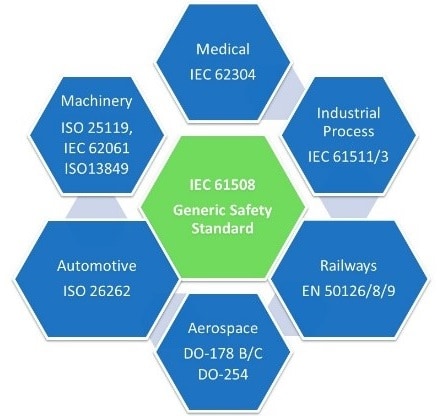
Functional Safety (FuSa) Services for Autonomous & Electric Vehicles, Industrial, Aerospace, and Defence (ISO 26262, IEC 61508)
Our expertise is not only limited to automotive domain but we also have executed projects including off-highway vehicles, defence and industrial control applications. Our domain expertise spans- electric vehicle, battery management systems, electric fuse boxes, high power charge controllers, Electronic Power Steering (EPS), Telematics Solutions, Body Control Module, , Powertrain ECU, Advanced Driver Assistance Systems (ADAS), and more.
Functional Safety and Technical Safety Concept Services
- Safety Risk Reduction and safety goals: Perform safety risk reduction using HARA/HAZOP on the item definition to identify Safety Goals, Safety functions and safe states with SIL or ASIL level.
- Identify safety regulations and standards: Identify the market legal regulations and safety standards that the product shall be compliant or certified to.
- Identify Fault Tolerance Time interval (FTTI): Determine and Specify the FTTI considering the application safety needs.
- Perform SIL Allocation and Decomposition: Allocated and Decompose ASIL or SIL targets to systems and sub items considering independency.
- Define Safety Architecture and Microcontroller selection (1001, 1002, 1002d or 2002): Redundancy architecture and micro controller selection is without any doubt the most crucial activity considering the development efforts, product cost, meeting CPU load target and safety goals with FTTI.
- Specify System Safety Requirements Specifications using safety analysis techniques to be used by the hardware, software and mechanical development
Successful Functional Safety Case Studies : Functional Safety projects in Automotive (ISO 26262) & Industrial (IEC 61508)
ASIL-D / SIL3 End to end Compliance for Electric Power Steering system
VerveTronics Role:
- Support for end to end ISO 26262 ASIL-D | IEC 61508 SIL3 compliance and certification
- Safety/Technical Concept and specifications ,
- Safety Analysis for System (HARA), Hardware(FMEDA), Software(FMEA) and Mechanical (FMEA)
- Safety Compliant Hardware Specifications and Assessment
- Hardware Design and development
- Safety Compliant Software Specifications, Validation and Assessment
- ASIL-D / SIL3 Process Development and Improvements
- Safety Assessment and Certifications
ASIL-B grade DC Power Converter System
VerveTronics Role:
- Safety/Technical Concept and specifications ,
- Safety Analysis for Hardware(FMEDA), Software (FMEA) and Mechanical (FMEA)
- Safety Compliant Hardware Specifications and Assessment
- Safety Compliant Software Specifications and Assessment
- Safety Assessment.
ASIL-C grade Electronics DC Protection System
VerveTronics Role:
- Support for end to end ISO 26262 ASIL-C compliance
- Safety/Technical Concept and specifications ,
- Safety Analysis for Hardware(FMEDA), Software (FMEA) and Mechanical (FMEA)
- Safety Compliant Hardware Specifications and Assessment
- Safety Compliant Software Specifications and Assessment
- ASIL-C / ASPICE Process Development and Improvements
- Safety Assessment
Team
Our consultants have experience developing safety critical electrical/electronic systems in a range of vehicle domains including powertrain, chassis, steering and braking systems, and more recently in hybrid/electric vehicles and Advanced Driver Assistance Systems (ADAS).
We have proven our expertise of our Functional Safety Consultants in Complex ISO 26262 (ASIL D/ ASIL C) Automotive projects and IEC 61508 (SIL 3 / SIL2 ) Industrial Projects.
We care about what we do!
 Functional Safety System Engineering & Safety Concept Development
VerveTronics provides Functional Safety system engineering and safety concept development services for safety-critical electrical, electronic and programmable systems across automotive, industrial, robotics, semiconductor and other safety-critical applications.
We help engineering teams translate product hazards and safety targets into practical, traceable safety requirements, safety functions and system architectures. Our work spans the transition from risk analysis and Safety Goals through Functional Safety Concept (FSC), Technical Safety Concept (TSC), system safety requirements, safety architecture, hardware/software allocation and verification planning.
Our engineering services support projects aligned with standards such as ISO 26262, IEC 61508 and ISO 13849, with the applicable standard and integrity framework determined by the product, industry and intended use.
The objective is to establish a safety architecture that is technically achievable, verifiable and traceable from the identified hazards through implementation and objective verification evidence.
- Translating hazard and risk analysis into clear, testable safety requirements.
- Deriving Safety Goals or safety functionsappropriate tothe applicable standard and product.
- Determiningrequired ASIL, SIL or PL-related targets where applicable.
- Allocating safety requirements between system, hardware,softwareand mechanical elements.
- Defining safe states, faultreactionsand degradation strategies.
- DeterminingFault Tolerant Time Interval (FTTI) and required safety reaction time where applicable.
- Designing architectures that achieve the required independence,redundancyand diagnostic capability.
- Managing ASIL decomposition or other integrity allocation strategies without creating unjustified independence assumptions.
- Selecting microcontrollers, processors, sensors,actuatorsand safety mechanisms that support the safety architecture.
- Balancing fail-safe and fail-operational concepts against performance,costand complexity.
- Defining diagnostic coverage, faultdetectionand fault reaction requirements.
- Managing dependent, common-cause and cascading failures.
- Maintainingbidirectional traceability from hazards to requirements, architecture and verification.
- Ensuring that safety requirements are sufficiently precise for hardware and software implementation.
- Planning verification and validation evidence early enough to avoid late-stage safety gaps.
- Functional Safety system engineering is the bridge between safety analysis and product implementation. A robust safety concept should answer five fundamental questions: What can go wrong? What risk must be reduced? What safety function is required? How will the system achieve it? How will we prove that it works?
- Risk Analysis to Safety Objectives
- The process begins with the applicable hazard and risk analysis. Depending on the standard and domain, this may include HARA, HAZOP, risk assessment, Functional Hazard Assessment or other structured methods. The resulting Safety Goals, safety functions or risk-reduction objectives provide the foundation for downstream safety requirements.
- Safety Requirements Engineering
- Safety objectives are decomposed into functional and technical safety requirements. Requirements should define the required behavior, triggering conditions, safe state or fault reaction, timing constraints, diagnostic expectations and verification method where applicable.
- Functional Safety Concept
- The Functional Safety Concept defines how the product will achieve the safety objectives at the functional/system level. Typical outputs include safety functions, safe states, fault reactions, degradation strategies, monitoring concepts, diagnostic concepts and allocation of safety responsibilities.
- Technical Safety Concept
- The Technical Safety Concept translates functional safety requirements into an implementable technical architecture. It defines technical safety requirements, system elements, hardware/software allocation, safety mechanisms, fault detection, fault handling and relevant architectural constraints.
- Safety Architecture
- Architecture development considers independence, redundancy, diagnostic coverage, fault containment, common-cause/dependent failures, timing, communication and system interfaces. For automotive applications this may include ASIL allocation/decomposition; for machinery applications the applicable ISO 13849 or IEC 62061 framework may be used; for IEC 61508 systems the relevant SIL and architectural constraints are considered.
- FTTI & Safety Reaction
- Where relevant, we support determination and allocation of timing constraints such as Fault Tolerant Time Interval and required fault-detection and reaction times. These constraints are translated into system, hardware and software requirements.
- Hardware / Software Allocation
- Safety requirements are allocated to system, hardware, software and other elements based on the safety architecture. Interfaces are explicitly defined so that safety assumptions and responsibilities remain traceable across engineering disciplines.
- Safety Mechanisms & Diagnostics
- We define appropriate mechanisms such as monitoring, watchdogs, plausibility checks, redundancy, diagnostics, communication monitoring, sensor supervision and fault reaction strategies based on the safety requirements and architecture.
- Verification Planning
- Every critical safety requirement should have an appropriate verification strategy. Verification planning is therefore developed alongside the safety concept rather than after implementation.
- Safety Lifecycle & System Safety Planning — Define the system safety lifecycle, activities, responsibilities, work products, reviews and engineering interfaces appropriate to the applicable standard and development model.
- Hazard Analysis & Risk Assessment — Support HARA, HAZOP, risk assessment and other structured safety analyses to identify hazards, hazardous events, safety objectives and required risk reduction.
- Safety Goal & Safety Function Derivation — Translate identified risks into Safety Goals, safety functions, safe states and fault reactions appropriate to the applicable domain and standard.
- Functional Safety Concept Development — Develop FSC-level safety requirements, safety functions, safe states, fault reactions, degradation strategies, monitoring concepts and diagnostic concepts.
- Technical Safety Concept Development — Develop TSC-level technical safety requirements, architecture, interfaces, hardware/software allocation, safety mechanisms, diagnostics and fault-handling strategies.
- Functional & Technical Safety Requirements — Define structured, testable safety requirements with allocation, traceability, assumptions, constraints and verification methods.
- Safety Architecture Design — Develop safety architectures addressing redundancy, independence, fault containment, diagnostics, communication, timing, fail-safe and fail-operational behavior.
- ASIL / SIL / PL Engineering — Support the applicable integrity-level allocation and architecture analysis for ISO 26262, IEC 61508, ISO 13849 or related frameworks. ASIL, SIL and PL are treated as standard-specific concepts rather than interchangeable ratings.
- ASIL Decomposition & Independence Analysis — For applicable ISO 26262 programmes, support decomposition strategies and analysis of independence, architectural assumptions and dependent failures.
- FTTI & Safety Timing Analysis — Determine and allocate relevant fault-detection, fault-reaction and system-response timing requirements.
- Hardware / Software Safety Allocation — Allocate technical safety requirements to hardware, software, mechanical or other system elements and define safety-related interfaces.
- Safety Mechanism & Diagnostic Architecture — Define monitoring, diagnostics, watchdogs, redundancy, plausibility checks, communication monitoring and fault-reaction mechanisms.
- Fail-Safe & Fail-Operational Architecture — Evaluate appropriate degraded, fail-safe or fail-operational behavior based on the intended function, hazard, fault tolerance and product requirements.
- FMEA, FTA & DFA Support — Use system-level FMEA, FTA, DFA and related analyses to validate the safety architecture and identify failure propagation and dependent-failure risks.
- Hardware & Software Safety Requirements — Provide safety requirements suitable for downstream hardware and software design, including allocation, interfaces and verification criteria.
- Safety Verification & Validation Planning — Define verification strategies, test requirements, fault-injection needs, traceability and validation activities for safety functions and requirements.
- Safety Case & Assessment Preparation — Organize safety arguments, evidence, requirements traceability, analysis results and technical documentation for safety assessment or independent certification readiness.
System Engineering Deliverables
- System safety requirements specification
- Functional Safety Concept
- Technical Safety Concept
- Safety-function specifications
- Safety architecture diagrams
- Hardware/software allocation
- Safety mechanism specifications
- Fault-reaction specifications
- FTTI and timing requirements where applicable
- Safety analysis inputs and outputs
- Interface and dependency specifications
- Verification and validation strategy
- Requirements traceability matrix
- Safety case inputs and assessment evidence
Electronic Power Steering & Vehicle Control Unit | ASIL-D / SIL3
VerveTronics supported a European Tier-1 programme involving end-to-end ISO 26262 ASIL-D / IEC 61508 SIL3 safety concept through certification support.
- Functional and Technical Safety Concept and specifications
- System HARA and hardware/software/mechanical safety analysis
- Hardware safety specifications and assessment
- Hardware design and development support
- Software safety specifications,validationand assessment
- ASIL-D / SIL3 process development and improvement
- Safety assessment and certification support
DC Power Converter | ASIL-B
- VerveTronics supported a European Tier-1 DC power converter programme targeting ASIL-B, including safety/technical concept, hardware and software safety analysis, safety-compliant hardware/software specifications and assessment support.
Electronics DC Protection System | ASIL-C
- VerveTronics supported a US Tier-1 electronics DC protection programme targeting ASIL-C, including end-to-end safety compliance activities, safety/technical concept, hardware/software safety analysis, safety-compliant specifications, ASPICE/process improvement and safety assessment.
- These case-study descriptions are based on the current VerveTronics page. Customer names and additional quantitative project details should only be published where disclosure is authorized.
- Automotive – ADAS, EV, BMS, powertrain, steering, braking, motor control, inverters, DC-DC converters, zonal/domain controllers, SDV and infotainment.
- Industrial – safety PLCs, controllers, industrial automation, process control, drives, power electronics,monitoringand protection systems.
- Robotics – industrial robots, AMRs, AGVs, collaborative robots, robot cells, autonomoussystemsand safety-related motion control.
- Semiconductors – safety MCUs, SoCs, sensors, PMICs, safety IP, automotive semiconductorplatformsand safety-related embedded components.
- Energy & Electrification – BESS, BMS, power converters, inverters, DC-DCconvertersand critical protection systems.
- Machinery – safety-related control systems, safety functions,PLr, Category,MTTFd, DCavg and CCF engineering.
- Off-Highway / Agricultural – safety-critical electrical/electronic systems and control functions.
- Medical – medical electrical equipment, embedded medical software and safety-critical electronics where the applicable medical-device framework requires system safety engineering.
- Other safety-critical embedded systems – products requiring structured risk reduction, safety architecture,requirementsand verification.
- Fixed-Scope Safety Concept Assessment – review of an existing FSC/TSC, architecture and requirements with a prioritized gap report.
- Safety Engineering Work Package – defined deliverables such as HARA, FSC, TSC, safety requirements,architectureor safety analysis.
- Dedicated System Safety Engineering Team – embedded engineers supporting the customer programme across system, hardware,softwareand safety activities.
- Expert Architecture Advisory – senior safety-engineering support for architecture decisions, integrity allocation, safetymechanismsand critical technical decisions.
- End-to-End Safety Concept Development – from risk analysis through FSC/TSC, architecture, requirements, verificationplanningand assessment preparation.
- Safety Assessment Readiness – compliance matrix, evidence review, traceability, safety case support, gapclosureand independent assessment preparation.
- What is Functional Safety System Engineering? – Functional Safety System Engineering is the discipline of translating identified hazards and safety objectives into safety requirements, safety functions, system architecture, hardware/software allocation, safety mechanisms and verification evidence.
- What is a Functional Safety Concept? – A Functional Safety Concept describes how the system will achieve its safety objectives at the functional level. Depending on the applicable standard, it can include safety functions, safe states, fault reactions, degradation strategies, monitoring and diagnostic concepts.
- What is a Technical Safety Concept? – A Technical Safety Concept translates functional safety requirements into technical implementation requirements and architecture, including system elements, interfaces, hardware/software allocation, safety mechanisms, diagnostics and fault handling.
- What is the difference between FSC and TSC? – The FSC describes the functional means of achieving the safety goals or safety objectives. The TSC translates those functional requirements into technical requirements and an implementable technical architecture.
- Why is safety architecture important? – Safety architecture determines how the system detects, controls and reacts to dangerous failures. It influences redundancy, independence, diagnostics, fault containment, hardware/software allocation, development effort and verification scope.
- What standards does VerveTronics support for safety concept development? – VerveTronics supports safety concept and system engineering aligned with standards including ISO 26262, IEC 61508 and ISO 13849, with the applicable standard determined by the product and industry.
- Does VerveTronics determine ASIL, SIL or PL? – VerveTronics can support the applicable risk analysis and integrity-level determination or allocation process. ASIL, SIL and PL belong to different standards and should not be treated as interchangeable.
- What is FTTI? – Fault Tolerant Time Interval is a timing concept used in applicable safety engineering contexts to describe the time available between a fault occurrence and the point by which a hazardous event could occur, considering required detection and reaction.
- Can VerveTronics develop safety requirements? – Yes. We can develop system, functional and technical safety requirements and establish traceability to hazards, safety functions, architecture, implementation and verification.
- Can VerveTronics support both hardware and software architecture? – Yes. Safety concept development includes hardware/software allocation and interface definition, with downstream hardware and software safety engineering available as separate or integrated work packages.
- Can VerveTronics support fail-operational systems? – Yes, where the product requires continued operation following defined faults. The appropriate architecture, redundancy, fault handling and safety objectives are determined from the application and applicable standard.
- Can VerveTronics perform Functional Safety Assessment? – VerveTronics can provide gap assessment, evidence preparation, safety case support and assessment readiness. Where independent formal assessment or certification is required, the applicable independent assessment/certification organization performs that activity.
- When should a company engage a Functional Safety system engineer? – Ideally during the concept and architecture phase, before major hardware and software design decisions are frozen. Early involvement helps establish achievable safety requirements and avoid costly architectural rework.
- Can an existing product be analyzed for Functional Safety? – Yes. Existing architectures can be reviewed through gap assessment, risk analysis, safety-function analysis, FMEA/FTA/DFA, requirements review, architecture assessment and verification-evidence analysis.
- How does Functional Safety System Engineering relate to hardware and software safety? – System engineering defines the safety objectives, requirements, architecture and allocation. Hardware and software safety engineering then implements the allocated requirements and provides detailed verification evidence.
VerveTronics can support your programme from hazard and risk analysis through safety requirements, FSC/TSC, architecture, hardware/software allocation, safety mechanisms, verification planning and assessment readiness.
Contact VerveTronics at contact@vervetronics.com or call +91 9021506588 to discuss your Functional Safety system engineering requirements.