DO-178C & DO-254 Aerospace Safety Consulting, Engineering & Certification Support

VerveTronics provides DO-178C and DO-254 consulting, engineering, verification and certification support for safety-critical aerospace, avionics, defence, UAV, UAS, eVTOL and airborne electronic systems. Our aerospace safety engineering services support organizations developing airborne software and airborne electronic hardware across the development and certification lifecycle—from system safety assessment, requirements and architecture through software/hardware development, verification, validation, compliance evidence and certification readiness. We support DO-178C software development assurance and DO-254 airborne electronic hardware design assurance, together with system-level safety engineering activities aligned with ARP4754A, ARP4761A and applicable certification requirements.Our engineering teams support programs targeting Design Assurance Levels (DAL) A through E, including flight-critical and mission-critical systems.

Need support with an Functional Safety project? Contact our Functional Safety experts

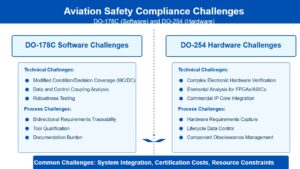
Modern aircraft and autonomous aerospace platforms increasingly depend on complex software, FPGA-based electronics, processors, communication systems, sensors, flight-control computers and mission systems. As system complexity increases, aerospace organizations must demonstrate that the development process, engineering activities and verification evidence provide the required level of assurance for the intended aircraft function. 

  • Typical challenges include:
  • Establishing an appropriate system safety and development assurance strategy
  • Allocating system functions and requirements to hardware and software 
  • Determining appropriate Development Assurance Levels / DAL 
  • Developing complete and consistent certification plans 
  • Establishing bidirectional requirements traceability 
  • Developing safety-critical airborne software according to DO-178C objectives 
  • Developing complex airborne electronic hardware according to DO-254 objectives 
  • Managing FPGA, ASIC, PLD and complex electronic hardware development 
  • Achieving structural coverage and verification objectives 
  • Demonstrating independence of verification activities where required 
  • Managing requirements, configuration and change control 
  • Qualifying or assessing development and verification tools where applicable 
  • Managing COTS devices, IP and previously developed hardware/software 
  • Generating objective evidence required for certification 
  • Preparing for authority reviews, conformity activities and certification audits 

FAA guidance recognizes DO-178C/ED-12C and DO-254/ED-80 as important industry development-assurance standards for airborne software and electronic hardware.

VerveTronics helps aerospace organizations integrate these activities into a structured engineering lifecycle rather than treating certification evidence as a documentation exercise at the end of development. 

Need support with an Functional Safety project? Contact our Functional Safety experts

VerveTronics combines system safety engineering, hardware engineering, software engineering, safety analysis and verification expertise to support complex aerospace development programs. 

  • Aerospace Safety & Design Assurance Expertise 
  • Our consultants and engineers support: 
  • DO-178C software development assurance 
  • DO-254 airborne electronic hardware design assurance 
  • ARP4754A system development processes 
  • ARP4761A safety assessment activities 
  • Functional Hazard Assessment (FHA) 
  • Preliminary System Safety Assessment (PSSA) 
  • System Safety Assessment (SSA) 
  • Fault Tree Analysis (FTA) 
  • Failure Modes and Effects Analysis (FMEA) 
  • Common Cause Analysis (CCA) 
  • Requirements engineering and traceability 
  • Hardware/software safety architecture 
  • Verification and validation 
  • Certification evidence and compliance preparation 

End-to-End Engineering Capability 

We can support individual engineering work packages or provide an integrated safety engineering team covering: 

System → Safety → Hardware → FPGA → Software → Verification → Certification Evidence 

VerveTronics combines aerospace domain knowledge with system, hardware, software and safety engineering expertise. 

Our differentiators include: 

  • DO-178C and DO-254 engineering expertise 
  • System-level safety assessment capability 
  • Hardware + FPGA + software engineering 
  • Safety analysis and reliability engineering 
  • Requirements and traceability expertise 
  • Verification and validation capability 
  • UAV/UAS and avionics experience 
  • Defence and mission-system experience 
  • Certification-readiness support 
  • Flexible India-based engineering delivery 
  • Global customer support across North America, Europe and India 

Our approach is focused on engineering outcomes and objective evidence, not documentation alone.

Need support with an Functional Safety project? Contact our Functional Safety experts

Aerospace System Safety Engineering 

We support system-level safety engineering activities that establish the foundation for DO-178C and DO-254 development. 

Services include: 

  • Functional Hazard Assessment (FHA) 
  • Preliminary System Safety Assessment (PSSA) 
  • System Safety Assessment (SSA) 
  • Failure condition analysis 
  • Safety requirements development 
  • Safety requirements allocation 
  • Development Assurance Level allocation 
  • Functional and technical architecture 
  • Fault tree analysis 
  • FMEA/FMECA 
  • Common Cause Analysis 
  • Dependency and interface analysis 
  • Safety requirements traceability 
  • Safety assessment documentation 

Our system-level safety activities help establish the safety and assurance objectives that flow into airborne hardware and software development. 

 DO-178C Software Consulting 

VerveTronics provides DO-178C software engineering and certification support for safety-critical airborne software. 

Our services include: 

  • Software Planning 
  • Plan for Software Aspects of Certification (PSAC) 
  • Software Development Plan (SDP) 
  • Software Verification Plan (SVP) 
  • Software Configuration Management Plan (SCMP) 
  • Software Quality Assurance Plan (SQAP) 
  • Certification planning 
  • Software life-cycle definition 
  • Software Requirements 
  • High-Level Requirements 
  • Low-Level Requirements 
  • Requirements decomposition 
  • Requirements allocation 
  • Requirements consistency analysis 
  • Bidirectional traceability 
  • Requirements review 
  • Software Architecture & Design 
  • Software architecture 
  • Low-level design 
  • Interface definition 
  • Data and control flow 
  • Partitioning 
  • Safety-related software architecture 
  • Defensive programming 
  • Robustness considerations 
  • Software Development 
  • Safety-critical embedded software 
  • RTOS-based software 
  • Bare-metal software 
  • Device drivers 
  • Board support software 
  • Application software 
  • Communication software 
  • Flight-control software 
  • Mission-system software 
  • Software Verification 
  • Requirements-based testing 
  • Software unit verification 
  • Integration testing 
  • Hardware/software integration 
  • Structural coverage analysis 
  • Statement coverage 
  • Decision/branch coverage 
  • MC/DC analysis where applicable 
  • Robustness testing 
  • Review and analysis 
  • Verification independence 
  • Regression testing 
  • DO-178C Supplements 

Where applicable, we can support development approaches involving: 

  • DO-330 – Software Tool Qualification 
  • DO-331 – Model-Based Development and Verification 
  • DO-332 – Object-Oriented Technology and Related Techniques 
  • DO-333 – Formal Methods 

FAA guidance recognizes these DO-178C supplements, including DO-330, DO-331, DO-332 and DO-333, as associated guidance for applicable software development techniques. 

 DO-254 Hardware Design Assurance 

VerveTronics provides DO-254 airborne electronic hardware engineering and certification support for safety-critical avionics hardware. 

Our services include: 

  • Hardware Planning 
  • Plan for Hardware Aspects of Certification (PHAC) 
  • Hardware Development Plan 
  • Hardware Verification Plan 
  • Hardware Configuration Management 
  • Hardware Process Assurance 
  • Certification planning 
  • Hardware Requirements 
  • Hardware requirements development 
  • High-Level Requirements 
  • Low-Level Requirements 
  • Requirements allocation 
  • Requirements traceability 
  • Hardware/software interface requirements 
  • Derived requirements analysis 
  • Hardware Architecture 
  • Airborne electronic hardware architecture 
  • Processor-based systems 
  • FPGA-based systems 
  • CPLD/PLD systems 
  • ASIC-based systems 
  • PCB/board-level electronics 
  • Power electronics 
  • Interface electronics 
  • Redundancy and monitoring 
  • Fault detection and containment 
  • FPGA / Complex Electronic Hardware 
  • We support DO-254 activities for: 
  • FPGA development 
  • CPLD development 
  • ASIC-related development 
  • Complex programmable devices 
  • High-speed digital electronics 
  • Processor-based avionics 
  • Safety-critical electronic control systems 
  • Hardware Verification 
  • Requirements-based verification 
  • Design reviews 
  • HDL verification 
  • Simulation 
  • Test-bench development 
  • Hardware/software integration 
  • FPGA verification 
  • Fault injection 
  • Functional testing 
  • Timing verification 
  • Interface verification 
  • Configuration verification 
  • Verification evidence and traceability 

FAA AC 20-152A provides current FAA guidance on development assurance for airborne electronic hardware and recognizes ED-80/DO-254, with additional guidance for areas including custom devices, COTS IP/devices and circuit-board assemblies. 

 Aerospace Safety Analysis & Reliability Engineering 

VerveTronics performs safety analyses across system, hardware and software development. 

Our services include: 

  • Functional Hazard Assessment 
  • Preliminary System Safety Assessment 
  • System Safety Assessment 
  • FMEA / FMECA 
  • Fault Tree Analysis 
  • Common Cause Analysis 
  • Dependency analysis 
  • Failure propagation analysis 
  • Fault containment analysis 
  • Reliability analysis 
  • Safety mechanism analysis 
  • Hardware failure analysis 
  • Software safety analysis 
  • Fault injection analysis 

We connect safety analysis results to requirements, architecture and verification evidence to maintain end-to-end traceability. 

 DO-178C / DO-254 Verification & Validation 

Verification is a central element of aerospace development assurance. 

VerveTronics supports: 

  • Requirements verification 
  • Design verification 
  • Implementation verification 
  • Software verification 
  • Hardware verification 
  • Integration verification 
  • System-level testing 
  • Hardware/software integration testing 
  • Requirements-based testing 
  • Structural coverage analysis 
  • MC/DC analysis 
  • Fault injection 
  • Robustness testing 
  • Regression testing 
  • Verification procedure development 
  • Verification evidence review 
  • Traceability analysis 

Our V&V activities can be integrated with existing customer development teams or delivered as independent verification work packages where the applicable program requirements call for independence. 

 DO-178C / DO-254 Compliance & Certification Support 

VerveTronics supports aerospace organizations in preparing the technical evidence required for certification activities. 

Services include: 

  • DO-178C gap assessment 
  • DO-254 gap assessment 
  • Certification planning 
  • Compliance checklist development 
  • Certification data review 
  • Requirements traceability review 
  • Process compliance review 
  • Verification evidence review 
  • Configuration management review 
  • Problem report / change impact analysis 
  • Certification readiness assessment 
  • Audit preparation 
  • Authority review preparation 
  • Corrective-action support 
  • Certification evidence management 

VerveTronics provides engineering, consulting, assessment preparation and certification support. Formal regulatory approval or independent certification is performed by the applicable aviation authority or authorized/recognized certification organization. 

 Aerospace Functional Safety & Safety-Critical Engineering 

Although aerospace programs typically use the terminology of system safety, development assurance and design assurance, our Functional Safety engineering capabilities provide a complementary engineering foundation for safety-critical aerospace systems. 

We support: 

  • Safety requirements 
  • Safety architecture 
  • Fault detection 
  • Fault containment 
  • Fail-safe architectures 
  • Redundant architectures 
  • Monitoring and diagnostics 
  • Safety mechanisms 
  • Hardware/software partitioning 
  • Independence 
  • Requirements traceability 
  • Verification and validation 
  • Safety assessment 
  • Certification evidence 

The objective is to establish a consistent safety engineering framework from aircraft-level hazards through system, hardware and software implementation. 

DO-178C & DO-254 Design Assurance Levels 

VerveTronics supports aerospace programs across DAL A, DAL B, DAL C, DAL D and DAL E, depending on system function, failure-condition classification and applicable certification requirements. 

Typical areas of support include: 

Assurance Level  Typical Engineering Focus 
DAL A  Highest rigor for catastrophic failure-condition functions 
DAL B  High-integrity safety-related functions 
DAL C  Significant safety-related functions 
DAL D  Lower-level safety assurance activities 
DAL E  Functions with no safety effect 

The applicable DAL should be established through the system safety and certification process rather than selected solely at the software or hardware level. 

 DO-178C & DO-254 Standards and Related Guidance 

Our aerospace safety engineering services can be aligned with applicable standards and guidance including: 

  • RTCA DO-178C / EUROCAE ED-12C – Airborne Software 
  • RTCA DO-254 / EUROCAE ED-80 – Airborne Electronic Hardware 
  • ARP4754A – Guidelines for Development of Civil Aircraft and Systems 
  • ARP4761A – Guidelines and Methods for Conducting the Safety Assessment Process 
  • DO-330 – Software Tool Qualification 
  • DO-331 – Model-Based Development and Verification 
  • DO-332 – Object-Oriented Technology 
  • DO-333 – Formal Methods 
  • Applicable FAA Advisory Circulars 
  • Applicable EASA AMC/GM material 
  • Applicable aircraft and equipment certification requirements 

FAA and EASA materials recognize DO-178C/ED-12C and DO-254/ED-80 within the broader aircraft certification and development-assurance framework. 

Need support with an Functional Safety project? Contact our Functional Safety experts
Flight Control Systems

  • Flight control computers, Electronic flight control, Actuator control, Control electronics, Flight-control software, Redundant control architectures.

Avionics Systems

  • Integrated avionics, Mission computers, Display systems, Communication systems, Navigation systems, Data acquisition systems,Avionics processing units.

UAV / UAS

  • Flight-control systems, Autopilot systems, Mission computers, Ground-control interfaces, Navigation systems, Payload control, Autonomous flight systems.

Radar & Sensor Systems

  • Radar processing, Sensor interfaces, Sensor processing electronics, FPGA-based processing, Mission and surveillance systems.

Power & Electrical Systems

  • Power management units, Power distribution, Electrical control systems, Power converters, Battery management, Motor controllers, Electrical protection systems.

Defence& Mission Systems

  •  Mission computers, Weapon-system electronics, Communication systems, Surveillance systems, Navigation, Guidance systems, Electronic control systems.

Autonomous & eVTOL Systems

  • Flight-control architectures, Autonomous flight functions, Redundant computing, Sensor interfaces, Safety monitoring, Power and propulsion control, Safety-critical software and hardware.

Need support with an Functional Safety project? Contact our Functional Safety experts

We worked European OEM for Electronics Power Management Unit as per DO-178C/ DO 254 for end to end  concept to certification support for UAV system

VerveTronics Role:

  • Support for end to end DO-178C/ DO-254 compliance and certification
  • Safety/Technical Concept and specifications ,
  • Safety Analysis for System (HARA), Hardware(FMEDA), Software(FMEA) and Mechanical (FMEA)
  • Safety Compliant Hardware Specifications and Assessment
  • Hardware Design and development
  • Safety Compliant Software Specifications, Validation and Assessment
  • DO-178C/ DO-254 Process Development and Improvements
  • Safety Assessment and Certifications

Connect with us


We successfully contributed in development for a leading Tier-1 supplier of RADAR System according to DO-178C/ DO-254

VerveTronics Role:

  • Support for end to end IDO-178C/ DO-254 compliance
  • Safety/Technical Concept and specifications ,
  • Safety Analysis for Hardware(FMEDA), Software (FMEA) and Mechanical (FMEA)
  • Safety Compliant Hardware Specifications and Assessment
  • Safety Compliant Software Specifications and Assessment
  • DO-178C/ DO-254 Process Development and Improvements
  • Safety Assessment

Connect with us


We worked with a leading Tier-1 supplier  to develop Airborne Equipment Fire and Control System according to DO-178C/ DO-254

VerveTronics Role:

  • Safety/Technical Concept and specifications ,
  • Safety Analysis for Hardware(FMEDA), Software (FMEA) and Mechanical (FMEA)
  • Safety Compliant Hardware Specifications and Assessment
  • Safety Compliant Software Specifications and Assessment
  • Safety Assessment.

Connect with us

Our ISO 13849 Engineering Approach 

VerveTronics follows a structured People – Process – Tools – Engineering Evidence approach. 

  • People & Competence:- Aerospace safety engineers,  System safety engineers, Hardware engineers, FPGA engineers, Embedded software engineers,  Verification engineers, Certification specialists,  
  • Process:- Safety planning, Development planning, Requirements management, Configuration management,  Change management, Verification planning, Process assurance,  Certification planning,
  • Engineering:- System architecture, Hardware architecture,  Software architecture,  Safety analysis,  Implementation, Verification,  Validation,  
  • Evidence:- Requirements traceability,  Reviews, Analysis reports, Verification results,  Test results,  Coverage evidence,  Configuration records,  Compliance matrices,  Certification data,  

Our objective is to ensure that engineering activities and certification evidence evolve together throughout the lifecycle, reducing late-stage compliance gaps and rework. 

 ISO 13849 Consulting Engagement Models 

  • Engineering Work Packages:- Clearly defined aerospace engineering deliverables with agreed scope, schedule and acceptance criteria. 
  • Examples:- DO-178C software verification, DO-254 hardware verification, Safety analysis, Requirements engineering, Certification evidence review,  
  • Dedicated Aerospace Safety Engineering Team:- A dedicated team of system, hardware, software and verification engineers working as an extension of your engineering organization. 
  • Expert Consulting: Senior aerospace safety engineers for:- Architecture reviews, Safety assessments, DO-178C/DO-254 compliance, Certification strategy, Gap analysis, Critical technical decisions. 
  • Certification Readiness & Gap Assessment:- Independent technical review of processes, work products and evidence to identify gaps before formal certification activities. 
  • Managed Safety Engineering:- End-to-end management of defined aerospace safety and design-assurance work packages. 

Need support with an Functional Safety project? Contact our Functional Safety experts
Controls, Navigation & Connectivity defense

What Does Controls, Navigation & Connectivity Defense Involve?
The defense of these domains involves the implementation of multiple layers of protection designed to mitigate risks:
1. Control Systems Defense:

Power & Electrical Systems Defense

Power and electrical systems are the backbone of modern infrastructure. From energy generation plants to industrial facilities and residential areas, these systems ensure the smooth operation of essential services.

Sensors and Surveillance Defense

What are the Key Components of Sensors and Surveillance Defense?
1. Sensors:
Environmental Sensors: These sensors monitor temperature, humidity, gas emissions, pressure, and more to detect hazardous conditions like fires, leaks, or machinery failures.