In today’s increasingly connected world, industrial control systems (ICS) are critical to the operation of essential infrastructures such as energy grids, manufacturing plants, and water treatment facilities. However, the rise of cyber threats targeting these systems exposes industries to risks including operational disruption, data theft, and even catastrophic failures. Industrial environments, traditionally isolated from external networks, are now integrated with enterprise systems and the cloud, widening their vulnerability. This raises a key question: How can industries safeguard their ICS against evolving cyber threats? The answer lies in implementing a robust cybersecurity framework like IEC 62443, which provides a structured approach to securing industrial automation and control systems (IACS).
What VerveTronics Offers:
VerveTronics helps organizations secure Industrial Control Systems (ICS) through expert IEC 62443 compliance services, including risk assessments, security audits, control implementation, and ongoing support for continuous protection.
About IEC 62443
IEC 62443 is a series of standards published by the International Electrotechnical Commission (IEC) aimed at securing industrial automation and control systems (IACS). It provides comprehensive guidelines to protect these systems from cyber threats, addressing vulnerabilities that could compromise critical infrastructure. The standard is applicable across various industries, including energy, manufacturing, transportation, and water management.
The framework includes a set of requirements for system security, risk management, network protection, and secure system design. It is structured in a way that allows organizations to apply it at various levels, from individual devices and components to entire systems and organizational processes. IEC 62443 covers topics like access control, system integrity, and security monitoring, providing a holistic approach to cybersecurity.
Detailing the Problem:
The adoption of digital technologies in industrial environments has made ICS more interconnected than ever, but it has also introduced significant cybersecurity risks. While traditional IT security standards often focus on enterprise networks, industrial control systems face unique challenges due to their operational nature. ICS must maintain continuous uptime, often in environments where downtime is costly or dangerous. Additionally, ICS devices often use legacy technologies that weren’t designed with modern cybersecurity threats in mind, creating additional vulnerabilities.
Common problems include:
-
- Legacy Systems: Many industrial systems rely on outdated hardware and software that lack built-in security features, leaving them vulnerable to cyberattacks.
- Interconnectivity Risks: Increased connectivity between ICS and IT systems, as well as the integration of industrial systems with the cloud, creates new attack surfaces for hackers to exploit.
- Complex Security Requirements: Securing ICS is not just about protecting data; it also involves ensuring the integrity of physical processes, which can be affected by cyberattacks.
- Compliance Gaps: While many industries are aware of the importance of cybersecurity, few are well-versed in the specific requirements outlined by IEC 62443, leaving gaps in their security measures.
The result is an urgent need for organizations to adopt a comprehensive and industry-specific cybersecurity framework like IEC 62443 to mitigate risks and ensure the resilience of their ICS.
Why VerveTronics ?
VerveTronics stands at the forefront of industrial cybersecurity, with a proven track record of helping organizations implement IEC 62443 standards across multiple sectors. Our experts are deeply familiar with the complexities of industrial control systems (ICS) and the specific security needs of critical infrastructure industries. Combining years of experience, technical expertise, and an understanding of the evolving threat landscape, we equip organizations with the tools and knowledge to safeguard their ICS environments.
Core Strengths of VerveTronics
-
Specialized Expertise: We have extensive experience in industrial cybersecurity, particularly in implementing IEC 62443. Our team understands the nuances of ICS environments and the importance of balancing robust security with operational continuity.
-
Tailored Solutions: We provide customized solutions that meet the unique needs of your organization, whether in manufacturing, energy, or other critical sectors. Our approach aligns cybersecurity measures strategically with your business objectives, rather than offering a one-size-fits-all solution.
-
Holistic Approach: Our services cover risk assessments, system design, implementation, training, and ongoing support. We ensure your ICS is compliant with IEC 62443 while also optimized for resilience and long-term security.
-
Proven Track Record: We have successfully helped a wide range of clients secure their ICS environments. Our experience spans diverse industries, enabling us to address the specific challenges faced by each organization.
Our Approach
VerveTronics offers a comprehensive, phased approach to help organizations secure their ICS environments in alignment with IEC 62443 standards. Here’s how we ensure a smooth and effective transition to compliance:
-
Risk Assessments and Security Audits: We start by conducting thorough risk assessments to identify vulnerabilities in your ICS environment. Our team performs security audits to evaluate existing systems, processes, and protocols, pinpointing areas where IEC 62443 compliance may be lacking.
-
Tailored Cybersecurity Strategy: Based on the assessment findings, we develop a customized cybersecurity strategy that aligns with IEC 62443. This includes defining security requirements, implementing access controls, and establishing secure communication protocols to protect industrial systems from both internal and external threats.
-
System Design and Implementation: We assist in integrating security features into your existing systems and processes. This may include network segmentation, secure architecture design, and deployment of advanced monitoring tools to detect intrusions or anomalies in real time.
-
Training and Awareness Programs: A well-informed workforce is critical to maintaining an effective security posture. VerveTronics offers customized training programs to educate employees on ICS-specific cybersecurity risks and best practices for mitigation.
-
Ongoing Monitoring and Support: Compliance with IEC 62443 is a continuous effort. We provide ongoing monitoring of your ICS environment and periodic reviews to ensure that systems remain secure against evolving cyber threats.
-
Regular Updates and Audits: We assist organizations in preparing for external audits and ensure that security measures are consistently updated to meet the latest IEC 62443 requirements.
VerveTronics Case Studies/Solutions
VerveTronics has successfully worked with clients across various industries to develop and deploy safety compliant systems. Our case studies demonstrate our ability to implement cost-effective, safety-critical solutions that improve system performance while ensuring full regulatory compliance.
VerveTronics has successfully worked with clients across various industries to develop and deploy safety compliant systems. Our case studies demonstrate our ability to implement cost-effective, safety-critical solutions that improve system performance while ensuring full regulatory compliance.
VerveTronics has successfully worked with clients across various industries to develop and deploy safety compliant systems. Our case studies demonstrate our ability to implement cost-effective, safety-critical solutions that improve system performance while ensuring full regulatory compliance.
Knowledge Center
Cybersecurity Responsibilities of ISO 21434
Cyber Security ISO 21434 and Safety
IoT Device Security
 IEC 62443 Industrial & Robotics Cybersecurity Consulting
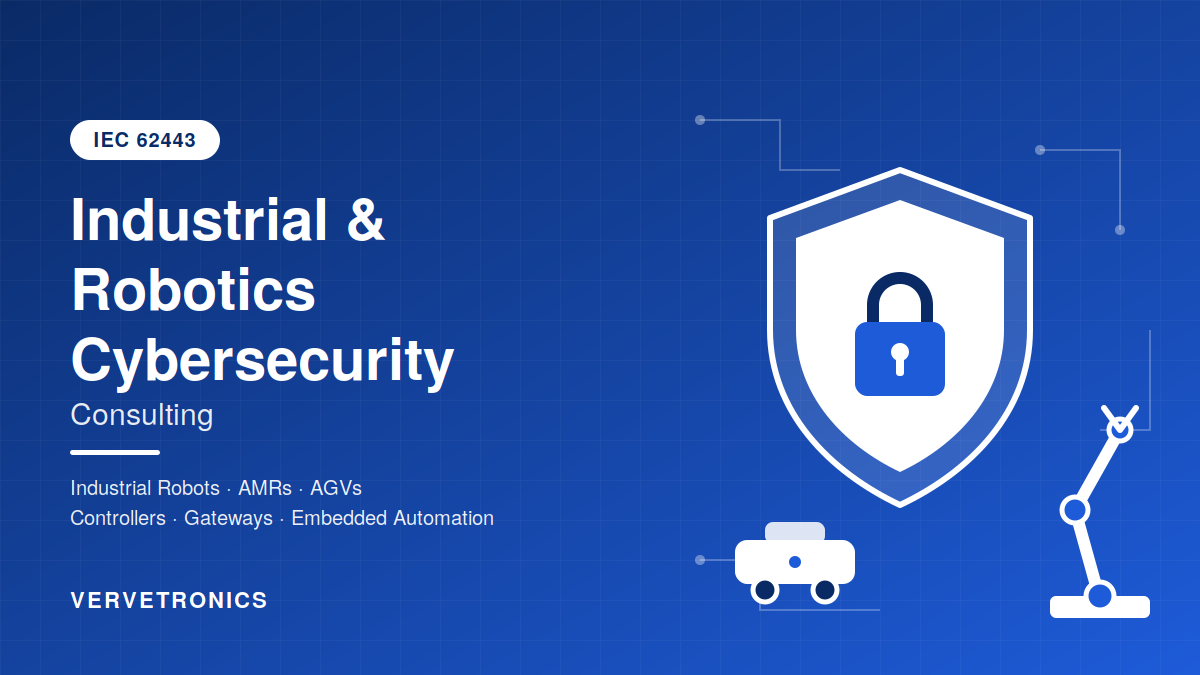
Secure industrial robots, AMRs, AGVs, controllers, gateways and embedded automation products with IEC 62443-aligned cybersecurity engineering. VerveTronics helps product suppliers and system integrators establish secure development processes, define component requirements, assess security capabilities and generate technical evidence.
- OT systems must balance cybersecurity with availability, deterministicoperationand safety requirements.
- Product teams need security requirements integrated into hardware,firmwareand software development rather than added after release.
- Patchability, vulnerability handling and long product lifecycles create ongoing security obligations.
- Customers may need todemonstratesecurity capability at product/component level as well as system level.
- IEC 62443-4-1 secure product development lifecycle gap assessment
- IEC 62443-4-2componentsecurity assessment
- Security requirements and security capability analysis
- Threat modeling and attack-surface analysis
- Security architecture for robot controllers and embedded devices
- Secure boot, firmware integrity,authenticationand access control review
- Industrial Ethernet, wireless,CANand protocol security assessment
- Vulnerability management and patch-management process
- Secure update/OTA architecture assessment
- Security verification, penetrationtestingand fuzzing coordination
- Security-level and evidence mapping support
- Supplier and product cybersecurity lifecycle assessment
Engineering Services by IEC 62443 Lifecycle Phase
VerveTronics supports cybersecurity engineering from product security planning through requirements, architecture, implementation, verification, release and post-release vulnerability management.
- Security planning & lifecycle definition — define security roles, lifecycle gates, evidence expectations and interfaces between engineering, quality,safetyand cybersecurity.
- Asset, interface & threat analysis —identifyassets, trust boundaries, attack surfaces and threat scenarios across controllers, sensors, actuators, wireless, Ethernet and cloud/fleet interfaces.
- Security requirements engineering — derive component/system requirements from threats and applicable IEC 62443 requirements, covering identification/authentication, authorization, integrity, confidentiality, restricted data flow, eventresponseand availability.
- Security architecture — design defense-in-depth for controllers and gateways, including trust boundaries, zones/conduits, secure boot, root of trust, cryptographic services, keystorageand access control.
- Hardware security engineering — assess MCU/MPU security features, HSM/secure elements, debug-port controls, memory protection, keyprovisioningand physical-access assumptions.
- Firmware & software security — review secure coding, privilege separation, authentication/authorization, cryptography, dependencies, logging, secure configuration, boot-chainvalidationand update mechanisms.
- Communication & protocol security — assess Ethernet, industrial protocols, wireless, CAN/CAN-FD and gateway paths for authentication, message integrity, replay protection, secureconfigurationand segmentation.
- Verification & security testing — plan and coordinate vulnerability assessment, penetration testing, fuzzing, protocol/negativetestingand security-function verification with traceability to requirements.
- Release, deployment & hardening — define secure configuration baselines, provisioning, credential/key handling, deploymentguidanceand release evidence.
- Vulnerability, patch & end-of-life management —establishvulnerability intake, triage, remediation, advisory, patch/update, regression and end-of-life processes.
- Compliance evidence & assessment support — map requirementstoarchitecture, implementation and verification evidence and prepare assessment-ready documentation.
- Industrial robots and robot controllers
- Collaborative robots and robotic cells
- AMR/AGV and autonomous mobile equipment
- PLCs,gatewaysand embedded controllers
- Factory automation and OT networks
- Machine vision and connected sensors
- Industrial IoT and edge devices
- Fleet management and cloud-connected robotics
Domains — Technical Cybersecurity Expertise
- Industrial robots & controllers — secure controller interfaces, boot chain, firmware, configuration data, serviceportsand controller-to-controller communications.
- Collaborative robots & robotic cells — cybersecurity across cobot controllers, teach pendants, safety interfaces, peripherals, cellnetworksand remote/service access, coordinated with functional safety.
- AMR/AGV — attack-surface analysis for vehicle controllers, sensors, wireless, fleet management, charging, navigation, remotediagnosticsand secure OTA; fleet-wide identity and key management.
- PLCs, gateways & embedded controllers — secure boot, firmware integrity, authentication, authorization, privilege separation, industrial protocol security, debugprotectionand cryptographic key handling.
- Factory automation & OT networks — zones/conduits, segmentation, industrial Ethernet, gateway interfaces, remote maintenance, assetinventoryand availability-focused defense in depth.
- Machine vision & connected sensors — device identity, firmware/update security, authenticated communications, configurationprotectionand integration risks.
- Industrial IoT & edge devices — secure lifecycle, cloud/edge trust boundaries, APIs/protocols, certificates/keys, provisioning, telemetryprotectionand vulnerability management.
- Fleet management & cloud-connected robotics — device-to-cloud authentication, command authorization, API security, remote diagnostics, secure softwareupdatesand credential rotation.
- IEC 62443-4-1 — secure product development lifecycle covering requirements, secure design, implementation, verification, defect management, patchmanagementand end-of-life.
- IEC 62443-4-2 — technical security requirements for IACS components covering identification/authentication, use control, integrity, confidentiality, restricted data flow, eventresponseand resource availability.
- IEC 62443-3-3 — system security requirements and security levels for IACS, useful when a device is evaluated within a defined automation/control architecture.
- IEC 62443-3-2 — system security risk assessment, zoning/conduits and target security levels feedingcomponentand architecture requirements.
- IEC 62443-2-1 / 2-4 — cybersecurity management andservice-provider/process considerations.
- ISO 10218 / ISO/TS 15066 — robot andcollaborative-robotsafety context to coordinate cybersecurity controls with safe operation.
- ISO 3691-4 — safety context for driverless industrial trucks/AMRs and coordination of cybersecurity with communications and safety functions.
- ISO 13849 / IEC 61508 — functional-safety context for safety-related control systems where cyber events may interact with safety functions.
- ISO/IEC 27001 — organizationalinformation-securitygovernance that can complement product cybersecurity engineering.
- NIST CSF / relevant NIST SP 800 guidance — complementaryrisk-management,systems-security and vulnerability-management practices.
Device-level implementation can include secure boot, root of trust, HSM/secure element, cryptographic key management, authenticated firmware, secure update/rollback protection, debug-port protection, secure diagnostics, network authentication, logging, vulnerability monitoring and security verification.
- AMR fleet cybersecurity architecture and attack-surface assessment
- Secure firmware and update mechanism review for industrial equipment
- IEC 62443-4-1 SDL gap assessment for an embedded product team
- OT communication and network-security assessment for a robotic system
Case Studies — Technical Scope & Expertise
- Embedded robot controller assessment — review boot chain, firmware update, authentication/authorization, debug access, cryptographic services,loggingand communication interfaces; map evidence to IEC 62443-4-2 requirements.
- AMR fleet cybersecurity architecture — model vehicle, charger, fleet manager, wireless and cloud interfaces;identifytrust boundaries and define device identity, command authorization, secure OTA and key-management controls.
- Secure firmware/update review — analyze bootloader, image signing, version/rollback controls, key storage, update transport and failure recovery for firmware authenticity and integrity.
- IEC 62443-4-1 SDL gap assessment — evaluate requirements, design, coding, verification, defect handling, vulnerabilitymanagementand end-of-life; create a lifecycle gap matrix and evidence roadmap.
- OT communication/network assessment — assess industrial Ethernet, wireless, gateway and protocol exposure for authentication, segmentation, replay,spoofingand unauthorized access; define controls and verification.
Approach
Scope the product → identify assets/interfaces → threat model → map IEC 62443 requirements → define security architecture → assess hardware/software controls → verify security functions → document evidence → establish vulnerability and patch lifecycle.
Engagement Models
- Product assessment
- SDL implementation program
- Component-level IEC 62443-4-2 assessment
- Robotics/AMR cybersecurity work package
- Independent security review and penetration-test preparation
- What is IEC 62443-4-1? – IEC 62443-4-1 specifies secure product development lifecycle requirements for products used in industrial automation and control environments, including requirements definition, secure design, implementation, verification, defect management, patch management and end-of-life.
- What is IEC 62443-4-2? – IEC 62443-4-2 specifies technical security requirements for IACS components and includes requirements for component security capabilities.
- Can IEC 62443 be applied to robots and AMRs? – Yes, where the product or system falls within the industrial automation/control security context. The applicability and exact parts should be scoped to the architecture and deployment.
- Do you assess embedded devices? – Yes. Embedded controllers, gateways and other component types can be assessed against applicable IEC 62443 requirements.
- Does IEC 62443 replace functional safety? – No. Cybersecurity and functional safety address different risks. For robotics, IEC 62443 can be coordinated with ISO 10218, ISO 3691-4, ISO 13849 or IEC 61508 as applicable.
- What is the difference between IEC 62443-4-1 and IEC 62443-4-2? – IEC 62443-4-1 focuses on the secure product development lifecycle, while IEC 62443-4-2 focuses on technical security requirements for IACS components. A product program may use both.
- What does Security Level mean in IEC 62443? – Security levels express resistance to different levels of attacker capability. Target security levels should be derived from the applicable risk assessment and architecture.
- Can VerveTronics support IEC 62443 certification or assessment? – VerveTronics can provide gap assessment, engineering, documentation, verification and technical evidence support. Formal certification or conformity decisions remain with the applicable independent assessment or certification body.
- IEC 62443-4-1:2018, Security for industrial automation and control systems — Secure product development lifecycle requirements.
- IEC 62443-4-2:2019, Security for industrial automation and control systems — Technical security requirements for IACS components.
- IEC 62443-3-2 and IEC 62443-3-3, system security risk assessment, securitylevelsand system security requirements.
- IEC 62443-2-1 and IEC 62443-2-4, cybersecuritymanagementand service-provider/process considerations.
- ISO 10218,Robotsand robotic devices — Safety requirements for industrial robots.
- ISO/TS 15066,Robotsand robotic devices — Collaborative robots.
- ISO 3691-4, Industrialtrucks— Driverless industrial trucks and their systems.
- ISO 13849 and IEC 61508,functional-safetystandards relevant to safety-related control systems.
- ISO/IEC 27001 and relevant NIST cybersecurity guidance as complementary practices.
Cybersecurity Responsibilities of ISO 21434
Cyber Security ISO 21434 and Safety
As vehicles become increasingly connected and software-driven, cybersecurity has become a cornerstone of ensuring functional safety. ISO/SAE 21434 provides a robust framework for managing cybersecurity risks across the lifecycle of automotive systems. By aligning closely with safety standards like ISO 26262, it ensures that digital threats are mitigated to prevent physical safety hazards.
IoT Device Security
IoT device security refers to the protection of IoT devices and the networks they connect to from cyber threats. It involves ensuring the confidentiality, integrity, and availability of data transmitted between IoT devices and their connected systems. This security covers various aspects, such as device authentication, data encryption, secure communication, and resilience against attacks.