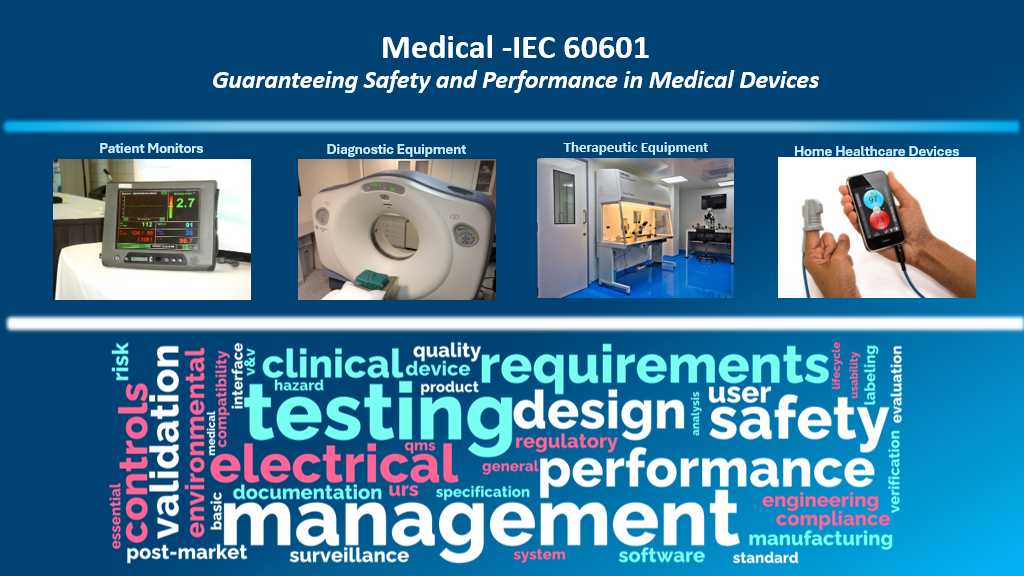
IEC 60601 & IEC 62304 Safety Compliance Challenges
- Stringent Regulatory Requirements: Medical electronics must comply with global safety standards, which require rigorous testing and validation.
- IEC 60601-1 – Safety & essential performance of medical devices
- IEC 62304 – Medical device software lifecycle processes
- ISO 13485 – Quality management for medical devices
- ISO 14971 – Risk management for medical electronics
- Reliability & Fail-Safe Operation in Life-Critical Devices: Medical devices must operate flawlessly, as failures can lead to severe injury or death.
- Single-Point Failure Risks: Malfunctions in ventilators, insulin pumps, or defibrillators can cause fatalities.
- Redundancy & Self-Diagnostics: Devices require backup power supplies, error detection, and self-correction mechanisms.
- Power Supply Failures: Many medical devices rely on battery-powered operation, requiring high energy efficiency and uninterruptible power sources (UPS).
- Electromagnetic Interference (EMI) & Radio Frequency (RF) Safety: Medical electronics must function in high-EMI environments such as hospitals, MRI rooms, and emergency settings.
- Long-Term Safety of Implantable Medical Devices: Implantable medical electronics (e.g., pacemakers, cochlear implants, neurostimulators) face long-term safety and durability challenges.
- Increasing Cyber Threats in Connected Medical Devices (IoMT): Medical devices are increasingly connected to hospital networks (Internet of Medical Things – IoMT), making them targets for cyberattacks.
Why VerveTronics ?
- Deep Expertise in IEC 60601 & IEC 62304: Our team has extensive experience with the IEC 60601 & IEC 62304 standard, ensuring that medical systems meet the required safety and security integrity levels.
- Deep Expertise in medical Electronics : With specialized experience in life support, surgical, radiology, imaging and medical robotics systems, VerveTronics is well-equipped to manage the safety challenges posed by medical electronics development.
- Holistic Approach to Safety and Security: We provide comprehensive functional safety services, from early-stage risk assessments to full-scale system validation, covering both hardware and software safety aspects.
- Safety Analysis and Risk Mitigation: We conduct in-depth safety analyses, including Failure Modes and Effects Analysis (FMEA) and Fault Tree Analysis (FTA), to identify and mitigate potential hazards.
- Training and Consulting: VerveTronics offers training and consulting sessions to enhance your team’s knowledge of functional safety and cyber security standards and methodologies, enabling them to manage safety-critical systems more effectively.
Our Approach
- Risk Assessment & Hazard Analysis (ISO 14971): Identifying, evaluating, and mitigating risks is essential for functional safety. Implement risk-based design improvements early to reduce hazards before product deployment.
- Compliance with Functional Safety Standards: Medical electronics must meet strict regulatory and safety standards, including:
-
- IEC 60601-1 – Electrical safety & essential performance of medical devices
- IEC 62304 – Medical device software lifecycle processes
- ISO 14971 – Risk management for medical devices
- ISO 13485 – Medical device quality management system
- Redundancy & Fail-Safe Design: Medical devices must have backup mechanisms to prevent catastrophic failures.
- Verification, Validation & Certification: Medical devices require strict testing and verification before regulatory approval.
- Secure Software Development Lifecycle (SDLC) & Threat Modeling: Implement threat modeling frameworks (STRIDE, DREAD) to preemptively mitigate cybersecurity threats.
Knowledge Center
IEC 60601 & IEC 62304 Medical Device Safety Consulting, Engineering & Certification services
VerveTronics provides IEC 60601 and IEC 62304 functional safety consulting, medical device safety engineering, embedded software engineering, verification and validation, risk-management integration, technical documentation and certification-readiness support for medical electrical equipment and software-enabled medical devices. Our engineering approach connects product hazards and risk controls to system architecture, hardware, software, verification evidence and regulatory documentation. This helps medical device manufacturers address safety and compliance as an engineering lifecycle rather than as a documentation exercise performed at the end of development. IEC 60601-1 establishes general requirements for basic safety and essential performance of medical electrical equipment, while IEC 62304 defines life-cycle requirements for medical device software. These standards can operate together with a broader medical-device development framework that may include ISO 14971 risk management, ISO 13485 quality management, applicable IEC 60601 collateral and particular standards, usability engineering and cybersecurity requirements.
- Meeting basic safety and essential performance requirements across complex medical electrical equipment.
- Identifying and controlling electrical, mechanical, thermal, energy, software and other product hazards as applicable to the device.
- Establishingrisk controls and maintaining their effectiveness throughout the product lifecycle.
- Translating risk-control measures into verifiable system,hardwareand software requirements.
- Developing medical device software using a controlled lifecycle aligned with IEC 62304.
- Establishingthe appropriate software safety classification and corresponding development and verification rigor.
- Managing software architecture, interfaces, SOUP, configuration management, changecontroland problem resolution.
- Maintainingbidirectional traceability from hazards and risks through risk controls, requirements, implementation and verification evidence.
- Managing hardware/software interactions and safety-related dependencies.
- Demonstratingessential performance under normal and relevant fault conditions.
- Addressing EMC and applicable IEC 60601 collateral orparticular standardsbased on device characteristics and intended use.
- Preparing objective evidence for audits, regulatory review,assessmentand certification activities.
- Coordinating cybersecurity considerations with safety engineering for connected and IoMT devices.
- Medical-device safety and safety-critical engineeringexpertise.
- IEC 60601 electrical safety and essential-performance engineering support.
- IEC 62304 medical device software lifecycle engineering.
- Integration of ISO 14971 risk-management activities with engineering work products.
- Hardware and embedded software safety engineering across product development.
- FMEA, FTA and structured hazard/risk analysis.
- Requirements engineering and end-to-end traceability.
- Verification and validation planning, testspecificationand execution support.
- Coordination of safety and cybersecurity engineering for connected medical devices.
- Compliance gap assessment, technical-document review, auditpreparationand certification-readiness support.
- Flexible engagement models ranging from focused work packages to dedicated engineering teams.
- IEC 60601-1 Safety Engineering — Basic safety and essential performance requirements, product architecture, safety requirements, risk controls, verification planning and technical evidence.
- IEC 60601 Collateral & Particular Standards — Identification and engineering support for applicable collateral and particular standards based on device type, intended use and regulatory pathway, including IEC 60601-1-2 for EMC where applicable.
- Medical Device Risk Management – ISO 14971 — Hazard identification, risk analysis, risk-control definition, residual-risk evaluation, FMEA/FTA and traceability between risks, controls and verification.
- IEC 62304 Software Lifecycle Engineering — Software planning, requirements, architecture, implementation, integration, verification, maintenance, configuration management and problem resolution.
- Medical Device Software Safety — Software safety classification, safety-related requirements, architecture, risk controls, fault handling, defensive design, interfaces and verification evidence.
- Software Requirements & Architecture — Software system requirements, architecture, detailed design, interfaces, decomposition, traceability and design reviews.
- Software Verification & Validation — Requirements-based testing, unit verification, integration testing, system testing, static analysis, code reviews, robustness testing, regression testing and traceability.
- SOUP & Third-Party Software Assessment — Identification and evaluation of software of unknown provenance, impact assessment, documented controls, configuration management and verification activities as applicable.
- Medical Electrical Hardware Safety Engineering — Power supplies, isolation, protection, monitoring, fault detection, safety mechanisms, safety requirements, hardware verification and hardware/software interfaces.
- FMEA, FTA & Safety Analysis — System, hardware and software FMEA; fault tree analysis; failure propagation; fault detection; safety mechanisms and dependent-failure analysis where applicable.
- Essential Performance & Fault-Condition Engineering — Definition and verification of essential performance and relevant behavior under normal and fault conditions according to applicable device requirements and risk controls.
- Medical Device Verification & Validation — System, hardware and software verification; validation planning; test requirements; traceability; fault testing and safety-related evidence as applicable.
- Medical Device Cybersecurity & Safety — Coordination of cybersecurity risk considerations with medical-device safety engineering for connected/IoMT devices, including threat modeling, security requirements and safety/security dependency analysis.
- Compliance Gap Assessment & Certification Support — Standards mapping, work-product review, technical-document review, evidence review, audit preparation and certification/assessment readiness.
-
IEC 62304 Software Lifecycle – Key Engineering Areas
- Software development planning and lifecycle definition.
- Software requirements analysis and bidirectional traceability.
- Software architecture and detailed design.
- Implementation and code-level engineering.
- Software unit verification.
- Integration and integration testing.
- Software system testing.
- Configuration management and change control.
- Problem resolution and anomaly management.
- Maintenance and software lifecycle evidence.
- Software safety classification andappropriate developmentand verification controls.
IEC 62304 defines life-cycle requirements for medical device software and applies to software that is itself a medical device or is embedded/integral to a final medical device. IEC 62304 should be applied together with the broader device risk-management, quality, verification, validation and regulatory framework applicable to the product.
-
IEC 60601 Engineering Lifecycle
- Device and intended-use definition.
- Applicable standards and regulatory strategy.
- Hazard identification and risk management.
- Basic safety and essential-performance requirements.
- System and hardware architecture.
- Software requirements and architecture.
- Risk-control implementation.
- Verification planning and test strategy.
- Hardware/software verification.
- System verification and validation.
- Technical documentation and objective evidence.
- Assessment, regulatorysubmissionand certification-readiness support.
- Life-support equipment – ventilators, patient-support systems and related electronics.
- Surgical systems – surgical equipment, electromechanicalsystemsand medical robotics.
- Radiology and imaging – imaging electronics, controlsystemsand embedded software.
- Patient monitoring – monitoring systems, sensors,displaysand alarms.
- Infusion and drug-delivery systems – pumps,controllersand safety monitoring.
- Laboratory and diagnostic equipment –analyzers,instrumentation and embedded systems.
- Medical robotics – robotic surgical and rehabilitation systems.
- Connected / IoMT devices – network-connected medical equipment and software.
- Portable and battery-powered medical equipment – battery, power,monitoringand protection systems.
- Recommended case-study format:
- Medical device type → applicable IEC 60601 / IEC 62304 scope →VerveTronicsrole → engineering deliverables → V&V / assessment outcome.
- Prioritize one detailed electrical/hardware safety case and one detailed IEC 62304 software case when documented evidence is available.
- Add a medical robotics case when the underlying project evidence can bedisclosed.
Do not publish fabricated customer names, device classifications, certification outcomes, project values or quantitative results. Where confidentiality applies, use an anonymized engineering case-study format.
- People – Knowledge & Competencies: Build and apply multidisciplinary competence across medical-device safety, hardware, embedded software, risk management and verification.
- Process – Lifecycle Governance: Define lifecycle activities, responsibilities, risk-management interfaces, requirements management, configuration management, change control and verification processes.
- Tools – Engineering & Automation: Use requirements management, traceability, static analysis, testing, fault analysis and evidence-management tools appropriate to the project.
- Engineering Evidence: Maintain traceability from hazard/risk → risk control → requirement → architecture → implementation → verification → residual risk.
- Continuous Improvement: Use lessons learned, defect trends, verification results and post-development changes to strengthen the safety lifecycle.
- Fixed-Scope Compliance Gap Assessment – standards mapping, work-product review and prioritized gap report.
- Engineering Work Package – defined IEC 60601, IEC 62304, ISO 14971, hardware,softwareor V&V deliverables.
- Dedicated Medical Device Safety Team – embedded safety, software,hardwareand V&V engineers supporting the customer programme.
- Expert Advisory – architecture reviews, risk-control decisions, software lifecyclestrategyand certification readiness.
- Managed Safety Engineering – end-to-end ownership of defined safety engineering workstreams.
- Assessment / Certification Readiness – evidence review, compliance matrix, auditpreparationand corrective-action support.
- What is IEC 60601? – IEC 60601 is a series of standards for medical electrical equipment. IEC 60601-1 provides general requirements for basic safety and essential performance, with applicable collateral and particular standards used where relevant.
- What is IEC 62304? – IEC 62304 defines life-cycle requirements for medical device software and establishes processes, activities and tasks for software development and maintenance.
- Is IEC 60601 the same as IEC 62304? – No. IEC 60601 primarily addresses medical electrical equipment safety and essential performance, while IEC 62304 addresses medical device software life-cycle processes. They can apply together to software-enabled medical electrical equipment.
- How does ISO 14971 relate to IEC 60601 and IEC 62304? – ISO 14971 provides the medical-device risk-management framework. Risk controls identified through risk management can then be implemented and verified through hardware, software and system development activities.
- What is essential performance under IEC 60601? – Essential performance is performance necessary to achieve freedom from unacceptable risk. The specific essential-performance characteristics depend on the device, intended use and applicable standards and risk analysis.
- Does IEC 62304 define software validation? – IEC 62304 defines software life-cycle requirements. It does not by itself cover validation and final release of the medical device; device-level validation belongs to the broader medical-device development and regulatory framework.
- What medical device software services does VerveTronics provide? – Software requirements, architecture, lifecycle support, verification, traceability, configuration and change management, safety analysis, testing and certification-readiness support.
- Can VerveTronics support IEC 60601 certification? – VerveTronics can provide consulting, engineering, gap assessment, test/evidence preparation and certification-readiness support. Formal conformity assessment or certification is performed by the applicable recognized or accredited organization.
- Can VerveTronics support both hardware and software? – Yes. The intended positioning is integrated medical-device safety engineering across electrical/hardware safety, embedded software, risk management and V&V.
- Can VerveTronics support connected medical devices? – Yes, subject to project scope. Safety engineering can be coordinated with medical-device cybersecurity and threat/risk analysis for connected devices.
- When should we involve a medical-device safety consultant? – As early as possible during intended-use definition, architecture and risk-management activities so safety requirements and risk controls can be incorporated before hardware and software design is frozen.
- Planning a new medical electrical product, upgrading an existing device, or preparing for IEC 60601 / IEC 62304 assessment?
- VerveTronics can support the programme from early risk analysis and safety architecture through hardware/software engineering, verification, technical documentation and certification readiness.
Contact VerveTronics at contact@vervetronics.com or call +91 9021506588 to discuss your medical-device safety engineering requirements.