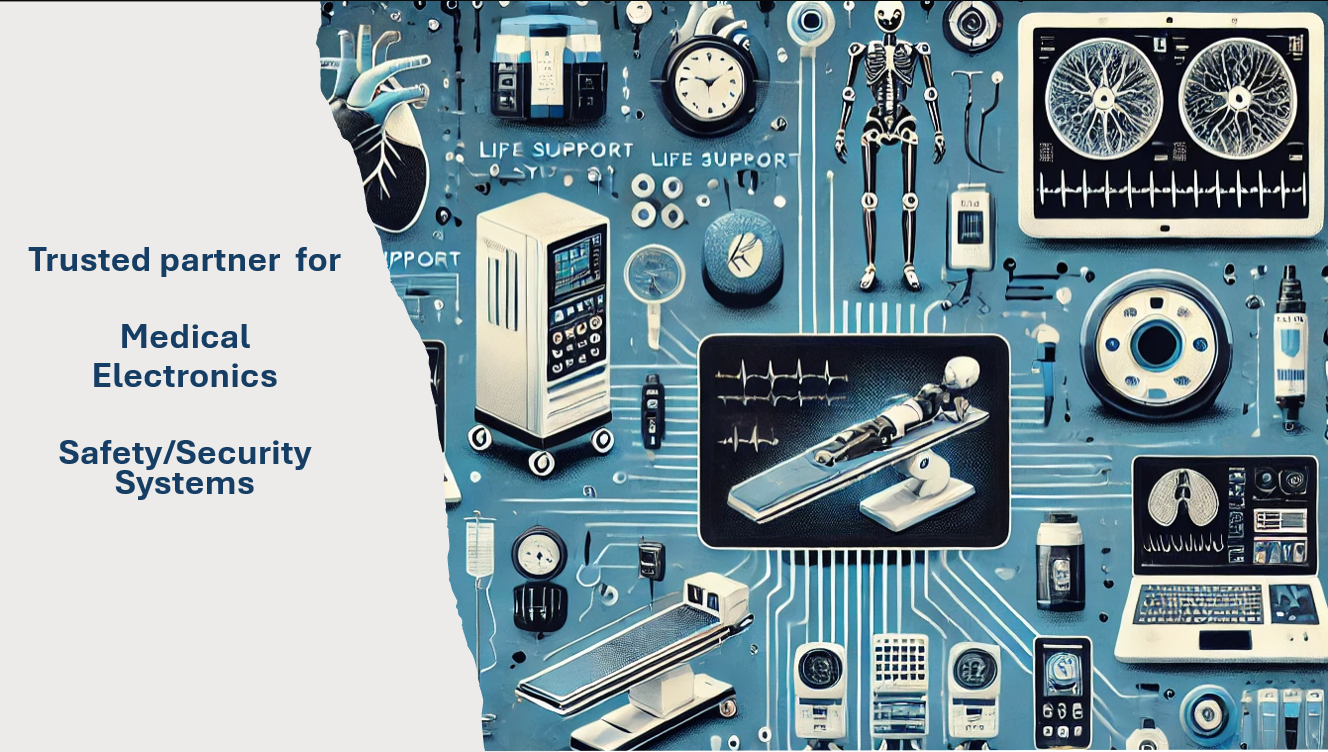
Domain Expertise in Safety/Security critical Medical Electronics
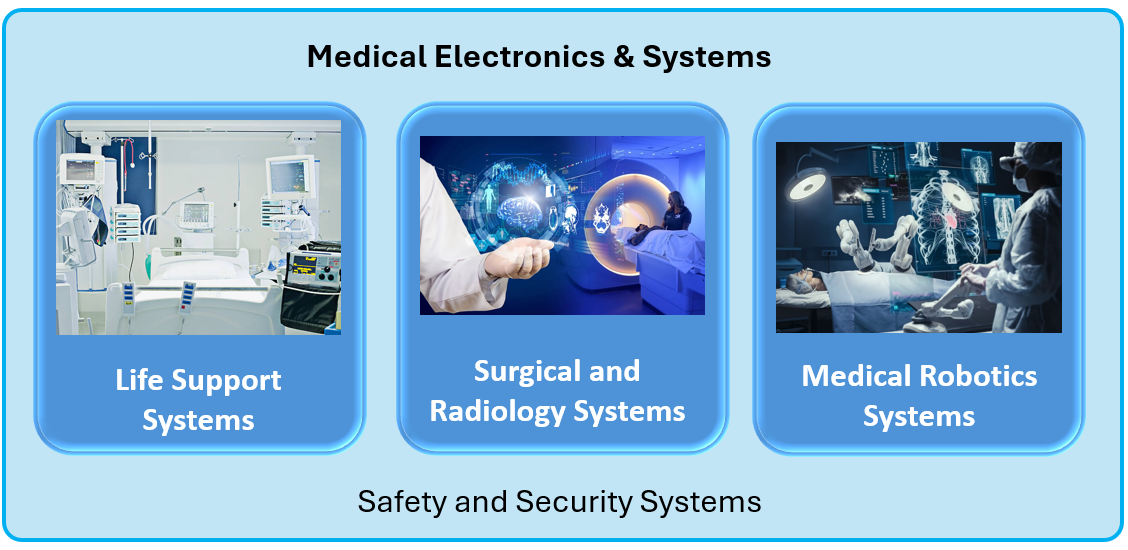
Life Support Systems
- Ventilators: Fail-safe systems to provide continuous and accurate airflow, with battery backups for power outages.
- Infusion Pumps: Ensure precise delivery of medications and fluids with alarms for flow rate deviations.
- Dialysis Machines: Protect patients from blood contamination, pressure imbalances, or fluid mismanagement.
- Pacemakers: Designed with fail-safe operation and protection against external interference
Surgical and Radiology Systems
- Electrosurgical Units (ESUs): High-frequency energy devices used in surgeries with safeguards against electrical burns and malfunctions.
- Laser Surgery Systems: Safety measures to protect against accidental exposure to high-intensity lasers.
- X-ray Machines: Shielding and safety interlocks to protect operators and patients from excessive radiation.
- MRI Systems: Electromagnetic compatibility (EMC) and noise shielding to ensure patient safety and image accuracy
- Electrocardiograms (ECG/EKG): Safe and accurate monitoring of heart activity, ensuring no electrical shocks or interference.
Medical Robotics Systems
- Exoskeletons: Safety mechanisms to prevent injury to users in physical rehabilitation.
- Automated Medical Assistants: AI-driven devices designed with motion control safety to avoid collisions.
- Pharmacy Robots: Ensures precise handling and dispensing of medication, avoiding cross-contamination.
- Robotic Surgery Platforms: Safe operation and fail-safe mechanisms to prevent errors during procedures.
Functional Safety & Security challenges in Medical Electronics
- Stringent Regulatory Requirements: Medical electronics must comply with global safety standards, which require rigorous testing and validation.
- IEC 60601-1 – Safety & essential performance of medical devices
- ISO 13485 – Quality management for medical devices
- ISO 14971 – Risk management for medical electronics
- Reliability & Fail-Safe Operation in Life-Critical Devices: Medical devices must operate flawlessly, as failures can lead to severe injury or death.
- Single-Point Failure Risks: Malfunctions in ventilators, insulin pumps, or defibrillators can cause fatalities.
- Redundancy & Self-Diagnostics: Devices require backup power supplies, error detection, and self-correction mechanisms.
- Power Supply Failures: Many medical devices rely on battery-powered operation, requiring high energy efficiency and uninterruptible power sources (UPS).
- Electromagnetic Interference (EMI) & Radio Frequency (RF) Safety: Medical electronics must function in high-EMI environments such as hospitals, MRI rooms, and emergency settings.
- Long-Term Safety of Implantable Medical Devices: Implantable medical electronics (e.g., pacemakers, cochlear implants, neurostimulators) face long-term safety and durability challenges.
- Increasing Cyber Threats in Connected Medical Devices (IoMT): Medical devices are increasingly connected to hospital networks (Internet of Medical Things – IoMT), making them targets for cyberattacks.
Why VerveTronics?
VerveTronics brings deep expertise in delivering functional safety and device cyber security solutions tailored to the medical electronics sector. Our core strengths include:
- Deep Expertise in IEC 60601: Our team has extensive experience with the IEC 60601 standard, ensuring that medical systems meet the required safety and security integrity levels.
- Deep Expertise in medical Electronics : With specialized experience in life support, surgical, radiology, imaging and medical robotics systems, VerveTronics is well-equipped to manage the safety challenges posed by medical electronics development.
- Holistic Approach to Safety and Security: We provide comprehensive functional safety services, from early-stage risk assessments to full-scale system validation, covering both hardware and software safety aspects.
- Safety Analysis and Risk Mitigation: We conduct in-depth safety analyses, including Failure Modes and Effects Analysis (FMEA) and Fault Tree Analysis (FTA), to identify and mitigate potential hazards.
- Training and Consulting: VerveTronics offers training and consulting sessions to enhance your team’s knowledge of functional safety and cyber security standards and methodologies, enabling them to manage safety-critical systems more effectively.
Our Approach
- Risk Assessment & Hazard Analysis (ISO 14971): Identifying, evaluating, and mitigating risks is essential for functional safety. Implement risk-based design improvements early to reduce hazards before product deployment.
- Compliance with Functional Safety Standards: Medical electronics must meet strict regulatory and safety standards, including:
-
- IEC 60601-1 – Electrical safety & essential performance of medical devices
- IEC 62304 – Medical device software lifecycle processes
- ISO 14971 – Risk management for medical devices
- ISO 13485 – Medical device quality management system
- Redundancy & Fail-Safe Design: Medical devices must have backup mechanisms to prevent catastrophic failures.
- Verification, Validation & Certification: Medical devices require strict testing and verification before regulatory approval.
- Secure Software Development Lifecycle (SDLC) & Threat Modeling: Implement threat modeling frameworks (STRIDE, DREAD) to preemptively mitigate cybersecurity threats.
Knowledge Center
Medical Device Safety & Security | IEC 60601, IEC 62304 & ISO 14971
VerveTronics provides medical device safety, risk management, embedded hardware/software safety and cybersecurity engineering for safety-critical medical electronics. Our expertise spans life-support systems, surgical equipment, radiology and imaging, medical robotics, patient monitoring and connected medical devices. We support development teams with risk analysis, safety requirements, electrical safety and EMC considerations, hardware/software safety engineering, verification and validation, cybersecurity engineering and regulatory-readiness activities.
- Patient-critical operation: Failure of a medical device can directly affect patient or operator safety, making hazard identification, risk control and verification central to product development.
- Electrical safety and essential performance: Medical electrical equipment must address electrical hazards and maintain essential performance under specified normal and fault conditions.
- EMC and coexistence: Devices may operate around RF transmitters, hospital networks, electrosurgical equipment and imaging systems, making electromagnetic compatibility an important design consideration.
- Software-intensive medical devices: Embedded software increasingly controls therapy, monitoring, alarms, diagnostics, motion and connectivity, creating lifecycle and verification challenges.
- Risk management across the lifecycle: Hazards, foreseeable misuse, risk controls and residual risks need to remain traceable through design changes and verification evidence.
- Single-fault and degraded operation: Life-support and therapeutic systems may require carefully designed fault detection, alarms, redundancy, backup power and controlled degraded modes.
- Medical robotics and motion safety: Surgical, rehabilitation and pharmacy robots combine software, motors, sensors, force/torque control and human interaction.
- Imaging and radiology risks: X-ray, MRI, laser and other diagnostic/therapeutic systems have application-specific electrical, EMC, radiation, motion and interlock considerations.
- Connected medical devices: Network connectivity and IoMT increase cybersecurity exposure and can create safety consequences when integrity or availability is compromised.
- Regulatory evidence: Product changes, software updates, risk controls and verification results need disciplined documentation and traceability.
Life Support & Critical Care
- Ventilators
- Infusion pumps
- Dialysis systems
- ECMO and heart-lung support systems
- Patient monitoring
- Defibrillation and emergency-care electronics
- Battery backup and power continuity
Surgical Systems
- Electrosurgical units
- Laser surgery systems
- Surgical control electronics
- Robotic surgery platforms
- Safety interlocks
- Energy delivery controls
- Emergency stop and fault-handling functions
Radiology & Medical Imaging
- X-ray systems
- MRI systems
- Imaging electronics
- Radiation-related safety controls
- Interlocks and monitoring
- High-voltage power electronics
- EMC and signal integrity considerations
Medical Robotics
- Robotic surgery
- Rehabilitation/exoskeleton systems
- Automated pharmacy robots
- Patient-assistance robots
- Motion control
- Force/torque sensing
- Collision detection and emergency stopping
Patient Monitoring & Diagnostics
- ECG/EKG
- Vital-sign monitoring
- Sensors and acquisition electronics
- Diagnostic systems
- Alarm management
- Data integrity and connectivity
Medical Power & Electronics
- AC/DC and DC/DC power supplies
- Battery management and backup power
- Protection circuits
- Power distribution
- Thermal monitoring
- Isolation and leakage-current considerations
Connectivity & IoMT
- Hospital network interfaces
- Wireless medical devices
- Remote monitoring
- Cloud-connected devices
- Device gateways
- Secure communication
- Software update and access-control mechanisms
| Standard / Framework | Primary focus | Typical relevance |
| IEC 60601-1 | Basic safety and essential performance of medical electrical equipment | Core medical electrical equipment safety framework |
| IEC 60601-1-2 | EMC requirements and tests | EMC/immunity/emissions considerations for medical electrical equipment |
| IEC 62304 | Medical device software lifecycle processes | Software development, maintenance and lifecycle controls |
| ISO 14971 | Risk management for medical devices | Hazard identification, risk estimation, risk control and residual risk |
| ISO 13485 | Medical device quality management system | Quality-management processes for medical-device organizations |
| IEC 62366-1 | Usability engineering | User-interface and use-related safety considerations |
| IEC 81001-5-1 | Health software/product cybersecurity | Cybersecurity activities for health software and health IT products where applicable |
| ISO 10993 series | Biological evaluation | Biocompatibility for applicable patient-contacting materials |
| IEC 60601 particular/collateral standards | Application-specific requirements | Particular equipment/application and collateral requirements as applicable |
Important SEO/content correction: IEC 62305 is primarily the IEC lightning-protection standard family, not the principal medical-device safety standard. For this Medical domain page, IEC 60601, IEC 62304, ISO 14971 and ISO 13485 should carry the primary medical-device search intent. If the user’s intended “IEC 62305” refers to a specific lightning-protection requirement for a facility or installation, it should be handled as a separate, clearly scoped topic rather than presented as a core medical-device lifecycle standard.
The current VerveTronics Medical page itself emphasizes IEC 60601-1, IEC 62304, ISO 14971 and ISO 13485, and the dedicated IEC 60601 page repeats that framework.
- Medical electronics specialization: The current VerveTronics Medical page covers life support, surgical, radiology, imaging and medical robotics systems.
- IEC 60601 expertise: The existing dedicated page positions VerveTronics around IEC 60601 and IEC 62304, including medical electrical safety, risk management, software lifecycle and verification/validation.
- Risk and safety analysis: Current medical content explicitly references FMEA and FTA for identifying and mitigating medical-device hazards.
- Lifecycle perspective: The existing approach covers risk assessment, compliance, redundancy/fail-safe design, verification, validation and certification-readiness activities.
- Safety + cybersecurity: The Medical page identifies IoMT cyber threats, while the robotics page addresses cybersecurity in connected medical robots.
- Cross-domain embedded expertise: VerveTronics’ broader positioning connects medical electronics with hardware, embedded software, safety analysis, V&V and cybersecurity engineering.
Medical Device Risk Management
- Hazard identification and risk analysis
- Risk management planning
- FMEA/FMECA
- Fault Tree Analysis
- Risk-control definition and verification
- Single-fault condition analysis
- Residual-risk evaluation and traceability
- Risk management file support
IEC 60601 Electrical Safety
- Basic safety analysis
- Essential performance analysis
- Electrical safety architecture
- Protection and isolation considerations
- Leakage-current and patient-protection considerations
- MOPP/MOOP design review
- Creepage and clearance review
- Power-supply and battery safety
- EMC/EMI engineering support
IEC 62304 Medical Software
- Software lifecycle planning
- Software safety classification support
- Software requirements
- Architecture and design review
- Verification and validation
- Unit/integration/system testing
- Traceability
- Configuration/change-management support
- Software safety evidence
Life Support Safety
- Ventilator safety
- Infusion pump safety
- Dialysis safety
- ECMO/critical-care equipment
- Alarm and monitoring safety
- Redundant sensing and control
- Backup power and safe shutdown
- Fault detection and degraded operation
Surgical & Radiology Safety
- Electrosurgical unit safety
- Laser system safety
- X-ray safety controls
- MRI safety-related electronics and interfaces
- Interlocks and fault handling
- Imaging-system safety analysis
- Power and control electronics
Medical Robotics Safety
- Robot risk analysis
- Motion-control safety
- Force/torque monitoring
- Collision detection
- Emergency-stop and protective-stop concepts
- Sensor/actuator fault handling
- HIL and software verification
- Cybersecurity threat modeling
Connectivity & Medical Cybersecurity
- Threat modeling
- Secure communications
- Access control
- Secure update strategy
- Data integrity and availability considerations
- Connected-device risk analysis
- Safety-security interface analysis
Verification, Validation & Assessment Support
- Verification planning
- System validation
- Hardware/software integration testing
- Fault injection
- HIL testing strategy
- Safety and risk-control verification
- Compliance evidence review
- Assessment and regulatory-readiness support
Training & Consulting
- IEC 60601 workshops
- IEC 62304 lifecycle training
- ISO 14971 risk-management workshops
- Medical cybersecurity awareness
- Safety analysis training
- Design and compliance reviews
Safety and security Systems
Life Support Systems
- The current VerveTronics Medical content identifies ventilators, infusion pumps, dialysis machines and other life-support systems as safety-critical applications, with emphasis on fail-safe operation, backup power, monitoring, redundancy and risk management
Safety and security Systems
Surgical & Radiology Systems
- The existing Surgical and Radiology page covers electrosurgical units, laser surgery, X-ray, MRI and ECG/EKG applications, emphasizing electrical safety, EMC, interlocks, fault detection and risk management.
Safety and security Systems
Medical Robotics
- The existing Medical Robotics page covers robotic surgery, rehabilitation systems, automated pharmacy robots and patient-assistance applications, including redundant motion control, force/torque sensing, emergency stopping, cybersecurity and HIL/software verification. .
- Perform safety risk management and cybersecurity threat modeling as coordinated engineering activities.
- Identify situations where loss, corruption, delay or manipulation of connected data could affect essential performance or risk controls.
- Define safe behavior for network loss, invalid commands, corrupted data and unavailable remote services.
- Consider authentication, authorization, secure communications and secure update mechanisms where applicable.
- Protect safety-related configuration and diagnostic interfaces from unauthorized changes.
- Maintain traceability between cybersecurity controls and the safety/risk-management architecture where their effects interact.
The current VerveTronics Medical page explicitly identifies connected medical devices/IoMT as cybersecurity targets, and the Medical Robotics page highlights cybersecurity risks for networked robots.
Engagement Models
- Medical safety work package – focused risk analysis, FMEA/FTA, IEC 60601 review, software lifecycle or V&V activity.
- End-to-end product safety engineering – from concept/risk management through design verification and regulatory-readiness.
- IEC 60601 compliance gap assessment – structured review of architecture, electrical safety, EMC and essential-performance evidence.
- IEC 62304 software assessment – lifecycle, requirements, architecture, verification and traceability review.
- ISO 14971 risk-management support – hazard analysis, risk controls, residual risk and verification evidence.
- Independent technical review – targeted review of safety engineering and compliance evidence.
- Training and workshops – IEC 60601, IEC 62304, ISO 14971, medical cybersecurity and safety analysis.
Primary CTA
Developing a safety-critical medical device? Talk to VerveTronics about IEC 60601, IEC 62304, ISO 14971, life-support, surgical, radiology, medical robotics or connected-device safety.
Secondary CTA
Need an IEC 60601 / IEC 62304 gap assessment or medical-device risk-management review? Share your product architecture, intended use and current compliance stage for an initial technical discussion.
- What is IEC 60601? – IEC 60601 is a major standards family for medical electrical equipment, addressing basic safety and essential performance along with applicable collateral and particular requirements.
- What is IEC 62304? – IEC 62304 specifies lifecycle processes for medical device software and is used to structure software development, maintenance and associated verification activities.
- What is ISO 14971? – ISO 14971 provides a risk-management framework for medical devices, including hazard identification, risk estimation, risk control and evaluation of residual risk.
- Is IEC 62305 a medical-device safety standard? – No. IEC 62305 is the IEC standard family for protection against lightning. It should not be presented as a core medical-device software/electrical safety standard. For this page, IEC 60601, IEC 62304, ISO 14971 and ISO 13485 are the primary medical-device standards.
- Why is IEC 60601 important for medical devices? – It addresses basic safety and essential performance of medical electrical equipment and provides a framework for electrical, mechanical, EMC and other applicable safety considerations.
- Can VerveTronics support IEC 60601 compliance? – The current VerveTronics Medical and IEC 60601 pages position the company around IEC 60601 safety engineering, risk analysis, hardware/software safety, verification/validation and compliance support.
- Can VerveTronics support IEC 62304 software safety? – Yes. The current Medical page explicitly includes IEC 62304 software lifecycle processes and software-related safety activities in its approach.
- Can VerveTronics support ISO 14971 risk management? – Yes. Existing Medical content identifies ISO 14971 risk assessment and hazard analysis as part of its approach, together with FMEA and FTA.
- What medical devices can VerveTronics support? – The current Medical domain covers life support, surgical, radiology, imaging, medical robotics and patient monitoring/diagnostics, along with connected medical devices.
- Can VerveTronics support ventilator safety? – The existing Life Support page specifically covers ventilators and highlights fail-safe operation, real-time monitoring, backup power, FMEA and risk management.
- Can VerveTronics support medical robotics safety? – Yes. Existing Medical Robotics content covers motion safety, redundant control, force/torque sensing, emergency stops, cybersecurity, HIL and software verification.
- Can VerveTronics support radiology and imaging safety? – Yes. The existing Surgical and Radiology page covers X-ray, MRI, laser and other systems, including safety controls, EMC, shielding/interlocks and risk management.
- Can medical-device safety and cybersecurity be addressed together? – Yes. Safety and cybersecurity have different objectives, but connected-device threats can affect the integrity or availability of safety-related functions. The current VerveTronics content explicitly addresses IoMT and connected medical-robot cybersecurity.
- Does VerveTronics provide medical-device certification? – The page should position VerveTronics as providing engineering, consulting, compliance and assessment-readiness support. Formal regulatory approval or certification remains subject to the applicable regulatory and conformity-assessment process.
- When should medical-device risk management start? – Risk-management activities should start early in product development and remain active throughout the lifecycle so hazards and risk controls influence architecture, design, verification and changes rather than being addressed only at the end