Functional Safety Verification & Validation Services
Our services include safety-requirement verification, unit testing, software integration testing, system integration testing, system-level safety validation, fault-injection testing, Hardware-in-the-Loop (HIL) testing, regression testing, performance and timing validation, static analysis, dynamic analysis and coverage analysis. Testing can be tailored to the applicable ASIL, SIL or project safety target.
The objective is not simply to demonstrate that a product works. Functional Safety V&V provides objective evidence that safety requirements have been correctly implemented, safety mechanisms respond as intended, faults are detected and handled within the required behavior, and the system reaches its specified safe or controlled state under defined conditions. The exact verification and validation scope depends on the product, architecture, safety requirements and applicable standard.
Need support with an Functional Safety project? Contact our Functional Safety experts
- Safety requirements are difficult to test directly: Safety requirements often describe fault reactions, diagnostic behavior, timing constraints and safe-state behavior. Test cases need to convert these requirements into observable pass/fail criteria.
- Normal-function testing is not enough: A safety mechanism can pass nominal tests while failing under the fault conditions for which it was designed. Fault insertion and fault-injection testing are therefore important where required by the safety concept.
- Traceability gaps: Assessments require evidence that safety requirements are verified and that test results cover the intended requirements. Weak bidirectional traceability can create major evidence gaps.
- Coverage is misunderstood: Statement, branch and MC/DC coverage measure different properties and do not by themselves prove functional safety. Coverage needs to be interpreted with requirements, structural analysis and safety objectives.
- HIL environments need safety-focused fault models: HIL testing becomes valuable when it can reproduce realistic sensor, actuator, communication, timing and ECU faults and observe the intended safety reaction.
- Regression testing becomes complex: Safety-related changes can affect existing safety mechanisms, diagnostics and interfaces. A controlled regression strategy is needed to demonstrate that previously verified behavior remains valid.
- Performance and timing can affect safety: A function may be logically correct but still fail its safety objective if execution time, communication latency or fault reaction exceeds the defined timing constraints.
Need support with an Functional Safety project? Contact our Functional Safety experts
| V&V Level | What Is Verified / Validated | Typical Techniques | Typical Evidence |
| Software Unit | Software safety requirements, unit behavior, boundary conditions, defensive mechanisms and low-level logic. | Unit testing, static analysis, dynamic analysis, code coverage, equivalence/partition testing where applicable. | Test specification, results, coverage reports, review records, defect/finding records. |
| Software Integration | Interactions between software units, components, BSW/application software and safety mechanisms. | Integration testing, interface testing, fault injection, timing tests, regression testing. | Integration test results, traceability, defect closure and regression evidence. |
| Hardware / ECU Integration | Hardware/software interaction, diagnostics, watchdogs, communication, I/O and safety mechanisms. | ECU integration tests, fault insertion, diagnostic tests, interface tests, timing/performance tests. | Test cases/results, logs, fault-response evidence, requirement traceability. |
| System Verification | System-level implementation of technical/safety requirements and intended fault reactions. | System integration tests, simulation, HIL, fault injection, scenario-based testing. | System verification reports, requirement coverage, test logs and issue closure. |
| Safety Validation | Whether the complete item/system meets its intended safety behavior in representative operating conditions. | System validation, fault scenarios, safe-state/controlled-state validation, HIL and target testing. | Validation plan/results, safety requirement evidence, scenario coverage and residual findings. |
| Regression / Release | Impact of changes on previously verified safety behavior. | Automated/manual regression, targeted safety regression, change-impact testing. | Regression reports, baseline comparison, release evidence. |
Fault-Injection & Safety-Mechanism Testing
Where applicable, testing should deliberately activate or emulate the faults considered by the safety concept and safety analyses. Examples can include sensor faults, stuck-at conditions, communication faults, memory faults, watchdog events, diagnostic failures, power anomalies, timing violations and safety-mechanism activation. The exact fault set must be derived from the product safety requirements and architecture rather than assumed generically.
Coverage & Static/Dynamic Analysis
- Static analysis for coding-rule compliance, defects and safety-related software quality checks.
- Dynamic analysis for runtime behavior and test execution evidence.
- Statement and branch coverage analysis where required by the development process.
- MC/DC coverage for applicable safety-critical software requirements and project criteria.
- Traceability from software safety requirements to test cases and results.
- Review of uncovered code, justified exclusions and residual coverage gaps.
Need support with an Functional Safety project? Contact our Functional Safety experts
- Safety Requirements Verification — Review and verify safety requirements for clarity, consistency, testability, allocation and traceability. Develop verification methods and acceptance criteria for safety-related requirements.
- Software Unit Testing — Safety-oriented unit testing for embedded software, including boundary conditions, defensive behavior, error handling and safety mechanisms as applicable to the project.
- Software Integration Testing — Integration testing for software components, interfaces, BSW/application interactions and safety mechanisms, including fault and timing scenarios where required.
- Hardware / ECU Integration Testing — Verify hardware/software interaction, diagnostics, watchdogs, communication, I/O behavior, fault reaction and safety mechanisms at ECU level.
- System Integration Testing — Verify that system components interact correctly and collectively implement technical safety requirements.
- Functional Safety Validation — Validate safety behavior at system/item level under representative operational and fault conditions.
- Fault Injection & Fault-Insertion Testing — Inject or emulate relevant faults to verify diagnostic detection, fault reaction, degradation behavior and safe/controlled-state transitions.
- HIL Testing — Develop and execute Hardware-in-the-Loop test scenarios for ECU and system safety functions, including fault injection, regression, performance and timing validation.
- Regression Testing — Safety-focused regression testing following software, hardware, calibration, requirement or architecture changes.
- Performance & Timing Validation — Verify execution time, communication timing, response time and fault reaction timing against applicable requirements and project constraints.
- Static & Dynamic Software Analysis — Support static-analysis and dynamic-analysis activities using appropriate tools and project-specific coding and coverage criteria.
- Coverage Analysis — Statement, branch and MC/DC coverage analysis where required, including review of uncovered code and evidence.
- Test Automation — Support reusable test environments, automated regression suites, test data management and repeatable safety test execution where appropriate.
- V&V Documentation & Assessment Evidence — Prepare test specifications, traceability, test reports, coverage evidence, anomaly records and verification/validation summaries suitable for project reviews and safety assessment.
Typical Deliverables
- Verification & Validation Plan / strategy
- Safety-requirement verification matrix
- Unit, integration and system test specifications
- Test cases and expected pass/fail criteria
- Fault-injection / fault-insertion test specifications
- HIL test scenarios and test reports
- Static-analysis reports and deviation records where applicable
- Statement, branch and MC/DC coverage reports where applicable
- Regression test specifications and results
- Performance and timing validation results
- Test logs, anomaly/defect reports and closure evidence
- Bidirectional requirements-to-test traceability
- Verification and validation summary reports
- Assessment-ready evidence package
Tools & Test Environments
The current VerveTronics page documents experience with a range of verification and testing tools. Tool selection should be based on project requirements, tool qualification needs, target architecture and customer environment.
- Static analysis: QA-C, LDRA, PolySpace and equivalent project-approved tools.
- Dynamic analysis and coverage: LDRA, VectorCAST and equivalent tools.
- Unit testing: VectorCAST, CANTATA, Tessy, RTRT, LDRA and equivalent environments.
- HIL and ECU/system testing: customer-specific or project-specific HIL environments, including fault-injection, regression, performance and timing testing.
- Tool qualification: where a tool is relied upon for safety-related evidence, assess applicable tool-confidence/tool-qualification requirements within the project safety lifecycle.
Standards & Safety Targets
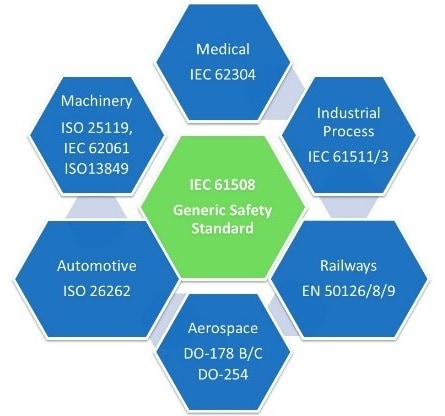
- ISO 26262 — Functional Safety for road vehicles, including verification and validation activities across relevant system, hardware and software lifecycle stages.
- IEC 61508 — Functional Safety of electrical/electronic/programmable electronic safety-related systems, including verification and validation activities appropriate to the lifecycle.
- ISO 13849 — machinery safety-related control systems; V&V scope tailored to safety functions and Performance Level requirements.
- ISO 25119 — agricultural/off-highway machinery where applicable.
- DO-178, DO-254— DAL A – E, Complex electronic hardware design assurance, gate-level/FPGA verification.
- EN 50129 / EN 50126 / EN 50129 : Safety case assurance, hardware fault tolerance, reliability
- IEC 62304 (Software) + ISO 14971 (Risk): Hardware-software risk integration, fault control measures, Class A – C
- Other sector-specific standards can be considered according to the product and project scope.
Need support with an Functional Safety project? Contact our Functional Safety experts
- ASIL-D / SIL3 Electric Power Steering System – European Tier-1
- End-to-end ISO 26262 / IEC 61508 support for a premium passenger-car application. The documented VerveTronics role included safety/technical concepts, safety analysis, hardware and software specifications, hardware development, software validation and assessment, ASIL-D/SIL3 process development and safety assessment/certification support.
- ASIL-B DC Power Converter System – European Tier-1
- Support for development of an ASIL-B DC Power Converter System, including safety/technical concepts, hardware FMEDA, software/mechanical FMEA, safety-compliant specifications and safety assessment.
- ASIL-C Electronics DC Protection System – US Tier-1
- End-to-end ISO 26262 ASIL-C support including safety/technical concepts, hardware FMEDA, software/mechanical FMEA, safety-compliant specifications, ASIL-C/ASPICE process development and improvement and safety assessment.
Need support with an Functional Safety project? Contact our Functional Safety experts
- Automotive & EV — ECUs, EV systems, battery management systems, electric fuse boxes, power electronics, EPS, powertrain, ADAS, telematics and body control systems.
- Industrial — industrial controllers, safety PLCs, drives, power electronics, instrumentation, energy systems and safety-related control systems.
- Off-Highway & Agricultural — mobile machinery, tractor and electrified off-highway control systems.
- Robotics — safety-related controllers, sensing, actuation and fault-response testing.
- Battery & Energy Storage — BMS, protection systems, power converters and safety mechanisms.
- Semiconductor & Embedded Platforms — safety-related MCU, SoC, memory, communication and power-management functions where appropriate test access is available.
- Aerospace & Defence — safety verification and validation support tailored to applicable assurance frameworks and project scope.
- Medical — safety-critical embedded/control systems where the applicable medical safety and software standards define the V&V scope.
Need support with an Functional Safety project? Contact our Functional Safety experts
- Complete V&V Work Package — Define and execute the required verification/validation scope from test planning through execution, analysis and reporting.
- Safety Software V&V — Focused unit, integration, static/dynamic analysis, coverage, fault and regression testing.
- ECU / Hardware-in-the-Loop Testing — Develop and execute HIL scenarios for safety requirements, fault reactions, diagnostics, performance and timing.
- Independent V&V / Assessment Support — Review existing V&V plans, test cases, coverage and evidence and identify gaps before customer or independent assessment.
- Fault-Injection Campaign — Focused campaign to verify safety mechanisms, diagnostics, fault reaction and safe/controlled-state behavior.
- Test Automation & Regression — Develop repeatable test suites and regression workflows for safety-related software and ECU functions.
- Embedded Safety Test Engineer — Provide experienced engineers integrated with the customer’s development and safety team.
Need support with an Functional Safety project? Contact our Functional Safety experts
- What are Functional Safety Verification and Validation Services? – Functional Safety V&V services provide objective evidence that safety requirements have been correctly implemented and that the complete product/system demonstrates the required safety behavior under defined operating and fault conditions.
- What is the difference between verification and validation? – Verification focuses on whether specified requirements and implementation outputs have been correctly realized. Validation focuses on whether the integrated item/system demonstrates the intended behavior and safety objectives in its intended operational context. The precise definitions and lifecycle activities depend on the applicable standard and project.
- What Functional Safety testing does VerveTronics provide? – The current VerveTronics service page documents unit testing, software integration testing, system-level validation, fault-injection testing, HIL testing, regression testing, performance and timing validation, static analysis and dynamic analysis including coverage.
- Can you support ISO 26262 ASIL-D testing? – The current VerveTronics page documents support for ISO 26262/IEC 61508 testing and V&V up to ASIL-D/SIL3. The exact test scope depends on the product, safety requirements, architecture and project evidence.
- Can you support IEC 61508 SIL3 verification and validation? – Yes. VerveTronics documents IEC 61508 V&V services and SIL3 project experience. The specific V&V activities depend on the safety lifecycle and system under development.
- Do you perform fault-injection testing? – Yes. Fault-injection testing is explicitly included in the current service description. Faults should be derived from the safety requirements, architecture and safety analyses so that the test campaign demonstrates meaningful safety behavior.
- What is HIL testing and why is it useful for Functional Safety? –
- HIL testing connects the real controller/ECU to a simulated plant or environment. It allows repeatable testing of system behavior, diagnostics, timing and fault scenarios without requiring every fault condition to be physically created on the final system.
- Do you provide MC/DC coverage analysis? – The current VerveTronics page documents dynamic analysis with statement, branch and MC/DC coverage using tools such as LDRA and VectorCAST. Applicability and required coverage should be defined by the project safety process and applicable standard.
- Can you test software safety requirements? – Yes. The current page specifically describes Software Safety Requirement verification and validation as part of the service scope.
- Can you perform ECU-level integration testing? – Yes. The current page documents ECU-level hardware and software integration testing, including fault injection, regression, performance and timing validation.
- Can you perform system-level safety validation? – Yes. System-level functional safety validation is explicitly included in the documented service offering.
- Can you perform regression testing after software changes? – Yes. Regression testing is part of the documented ISO 26262/IEC 61508 V&V service scope. The regression suite should be selected using change-impact and safety-requirement analysis.
- What inputs are needed to start V&V? – Typical inputs include safety requirements, technical requirements, architecture, software/hardware specifications, safety mechanisms, interface definitions, safety analysis outputs, test environment details and existing verification evidence. The minimum input set depends on the V&V scope.
- Do you provide test reports for safety assessment? – Yes. V&V documentation can be structured as assessment evidence, including test specifications, results, traceability, coverage, fault-injection evidence, anomalies and closure information.
- Do you provide certification? – VerveTronics provides verification, validation, engineering and certification/assessment support. Where formal independent certification is required, the applicable independent assessment or certification organization performs the formal certification activity.
- Need to verify and validate a safety-critical product?
- Share your safety requirements, architecture, development stage and target standard with our Functional Safety V&V team. We can help define the verification strategy, identify required fault scenarios, establish traceability and execute or review the evidence needed for your next development or assessment milestone.
- Request a Functional Safety V&V Consultation
- Get an ISO 26262 / IEC 61508 Test Scope Review
- Request Fault-Injection / HIL Testing Support
- Talk to a Functional Safety V&V Engineer
Need support with an Functional Safety project? Contact our Functional Safety experts