

Robotics Functional Safety | ISO 10218, ISO 3691-4 & ISO 13849
Our robotics safety expertise covers the robot itself, robotic systems and integration, mobile robot operation, safety-related control systems, sensing, motion control, protective functions, communication and fleet-level safety considerations.
The page should target both fixed industrial robot searches around ISO 10218 and mobile/driverless industrial truck searches around ISO 3691-4, while connecting these application standards to ISO 13849, IEC 61508, ISO 12100 and relevant collaborative-robot guidance.
- Human-robot interaction: Robots may operate close to people, requiring risk reduction measures, protective devices, safe stops and controlled motion.
- High-energy motion: Robot arms, end effectors, mobile bases and payloads can generate hazardous kinetic, crushing, trapping and impact energy.
- Complex robot cells: The safety of an integrated robot application depends on the robot, tooling, fixtures, conveyors, sensors, PLCs, guarding and operating modes—not only the robot controller.
- Autonomous mobile operation: AMRs and AGVs must manage navigation, obstacle detection, person detection, braking, steering, stability, speed and communication loss.
- Dynamic operating environments: Warehouses and factories continuously change layouts, traffic, people, pallets, vehicles and operating zones.
- Safety function allocation: Emergency stop, protective stop, speed limitation, collision avoidance and motion supervision may span sensors, controllers, communication networks and drives.
- Safety-rated perception: Laser scanners, cameras, encoders and other sensors must provide appropriate fault detection and safe reaction for the safety function being claimed.
- Manual, automatic and maintenance modes: Different operating modes can create different hazards and require controlled transitions and authorization.
- Communication and fleet control: Loss or corruption of wireless communication can affect safe operation, particularly for mobile robots and fleet-managed systems.
- Cybersecurity and safety: Unauthorized commands, compromised navigation data or control-network attacks can create safety consequences.
- Verification complexity: Safety functions must be validated under normal operation, foreseeable misuse, faults, degraded modes and relevant environmental conditions.
 Industrial Robots
- Articulated robot arms, SCARA robots, Delta robots, Cartesian robots, Robot controllers, End-of-arm tooling, Robot cells and production lines, Welding, painting, assembly and material handling .
Collaborative Robots / Cobots
- Human-robot collaboration, Power and force limiting, Speed and separation monitoring, Protective stops, Reduced-speed operation, Workspace and safeguarding assessment, Force/torque sensing.
AMR & AGV
- Autonomous mobile robots, Automated guided vehicles, Automated guided carts, Warehouse AMRs, Material-handling robots, Mobile robot steering and braking, Obstacle/person detection, Safe navigation and speed control .
Robot Cells & Machinery Integration
- Robot work cells, Conveyors and transfer systems, Machine interfaces, Safety PLCs, Safety I/O, Interlocked guarding, Light curtains and laser scanners, Emergency-stop architecture .
Autonomous & Intelligent Robotics
- AI-enabled perception, Vision systems, Autonomous navigation, Fleet management, Human-machine interaction, Remote diagnostics, Cloud/edge-connected robots, Degraded and fallback operation.
Industry Applications
- Automotive manufacturing, Electronics and semiconductor manufacturing, Warehousing and logistics, Food and packaging, Pharmaceutical and healthcare logistics, Heavy machinery, Energy and battery manufacturing, General industrial automation .
| Standard / Framework | Primary focus | Robotics relevance |
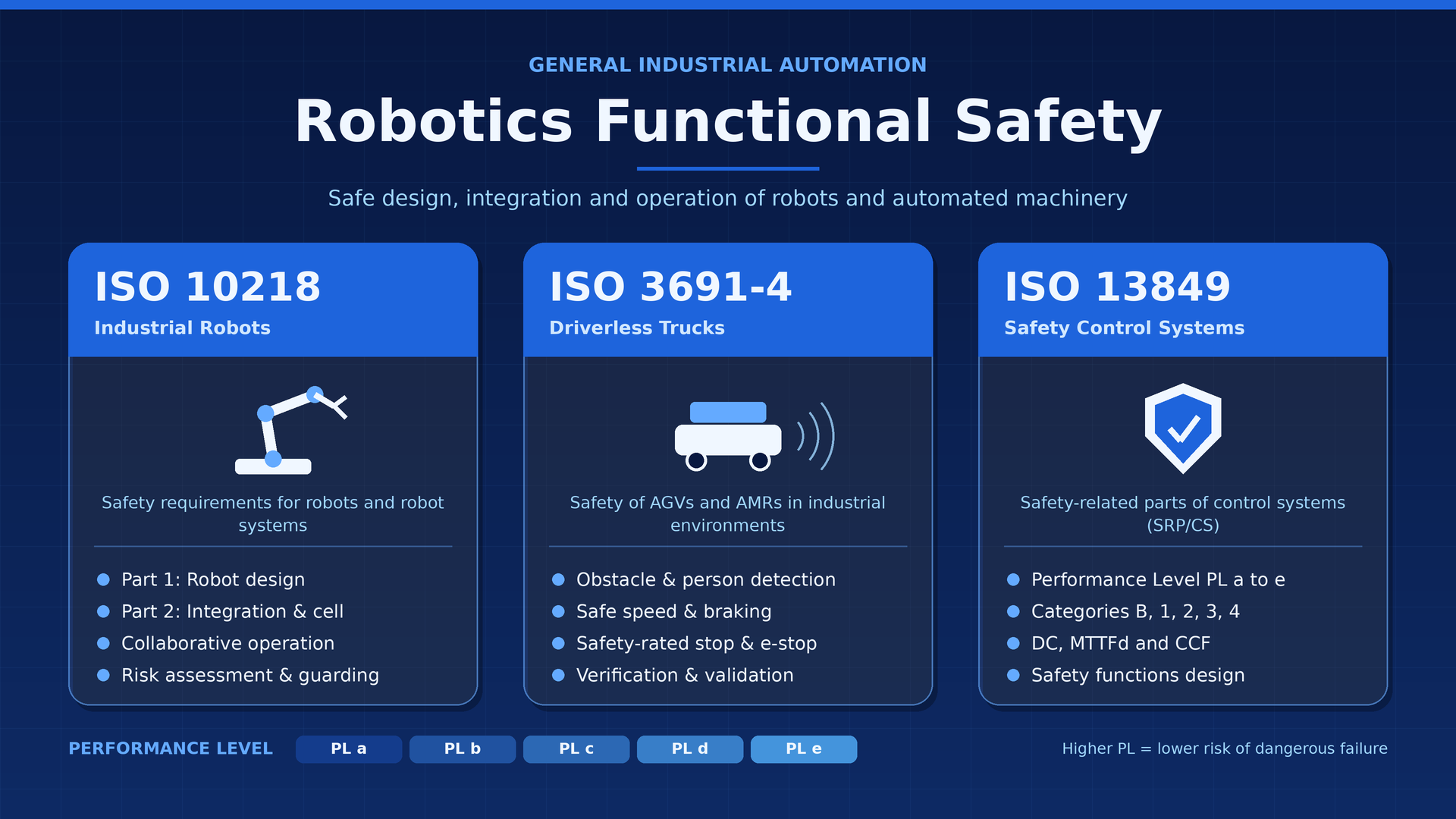
| ISO 10218-1:2025 | Safety requirements for industrial robots | Robot-level safety requirements; current published 2025 edition |
| ISO 10218-2:2025 | Robot applications and integration | Integration of industrial robots into complete applications/cells |
| ISO 3691-4:2023 | Driverless industrial trucks and their systems | AMRs, AGVs and other driverless industrial trucks; safety requirements and verification |
| ISO/DIS 3691-4 | Next revision of ISO 3691-4 | Draft under development in 2026; expected to replace the 2023 edition |
| ISO 13849-1/-2 | Safety-related parts of control systems | PL determination, architecture, diagnostics and validation |
| IEC 61508 | Functional safety of E/E/PE systems | Safety lifecycle and SIL framework for safety-related control/electronic systems |
| ISO 12100 | Machine risk assessment and risk reduction | Foundation for hazard identification and risk reduction in machinery applications |
| ISO/TS 15066 | Collaborative robot safety | Collaborative operation guidance used with applicable robot safety frameworks |
| IEC 62061 | Functional safety of machinery control systems | Alternative/complementary machinery functional-safety framework depending on application |
| IEC 62443 | Industrial automation cybersecurity | Cybersecurity for connected industrial automation/control environments |
Current standards note: ISO 10218-1:2025 is the published third edition and replaces ISO 10218-1:2011. ISO 10218-2:2025 is the corresponding current integration standard.
ISO 3691-4:2023 is the published second edition for driverless industrial trucks and their systems and explicitly includes examples such as automated guided vehicles and autonomous mobile robots. ISO is currently developing ISO/DIS 3691-4 as the next edition.
- Robotics-focused functional safety: Current VerveTronics content identifies ISO 10218, IEC 61508 and collaborative-robot safety as core robotics topics and describes safety/security across robots operating with people and machines.
- AMR/AGV expertise: VerveTronics’ functional-safety service page explicitly positions ISO 10218 / ISO/TS 15066 robotics consulting and AMR/AGV solutions, including SIL2/SIL3 and ISO 13849 PL d/PL e design and validation.
- End-to-end safety engineering: Existing service content covers risk analysis, safety requirements, architecture, hardware/software safety engineering, V&V, safety case and certification/assessment support.
- Safety + security: Current robotics content addresses cybersecurity and communication security alongside functional safety, which is particularly relevant to connected AMRs and autonomous systems.
- Control and sensing expertise: VerveTronics’ industrial/robotics material covers safety ICs, controllers, sensors, motor control and protective functions.
- Practical engineering approach: The broader functional-safety service portfolio includes FMEA, FMEDA, FTA, DFA, fault injection, HIL, static/dynamic analysis, testing and traceability.
Robot & Application Risk Assessment
- ISO 12100 hazard identification, Robot application risk assessment, Hazardous situation identification, Operating-mode analysis, Task and application analysis, Human-robot interaction analysis, Risk reduction strategy, Residual-risk evaluation .
ISO 10218 Robot Safety
- ISO 10218-1 robot safety requirements review, ISO 10218-2 application/integration safety review, Robot safety architecture, Emergency-stop functions, Protective-stop functions, Safety-rated monitored stop, Reduced-speed and safe-motion functions, Restart and mode-management safety, Guarding and protective-device architecture, Robot controller safety assessment .
ISO 3691-4 AMR / AGV Safety
- Driverless truck/AMR safety requirements, Operating-zone risk assessment, Person detection and safeguarding, Obstacle detection, Speed and separation concepts, Braking and stopping performance, Steering and stability safety, Load-handling safety, Automatic battery charging safety, Loss-of-communication behavior, Manual/automatic/maintenance mode safety, Fleet-control and interface safety, Safety-function verification .
ISO 13849 Functional Safety
- Safety-function identification, Required Performance Level (PLr), Category and architecture, MTTFd, DCavg, Common Cause Failure analysis, PFHd, Safety PLC and safety I/O architecture, Safety sensor/actuator selection, Verification and validation .
IEC 61508 Robotics Safety
- Safety lifecycle planning, Safety integrity requirements, SIL allocation/support, Safety requirements, Safety architecture, Hardware/software safety analysis, Diagnostic coverage, Fault reaction, Safety case and evidence, Assessment readiness .
Motion & Drive Safety
- Safe Torque Off, Safe Stop functions, Safe Limited Speed, Safe Limited Position, Safe Direction, Brake monitoring, Encoder/speed feedback diagnostics, Motor-drive fault handling, Motion supervision .
Safety Sensors & Protective Devices
- Safety laser scanners, Light curtains, Safety mats, Interlocked gates, Safety-rated encoders, Proximity and presence sensing, Vision-based detection, Force/torque sensors, Protective field configuration .
Verification, Validation & Testing
- Safety requirement verification, Safety function validation, Fault injection, HIL testing, Stopping-distance validation, Sensor diagnostic testing, Communication-loss testing, Mode-transition testing, Fault reaction timing, Regression testing, Evidence and traceability .
Robotics Cybersecurity
- Threat modeling, Robot controller security, Secure communications, Access control, Remote maintenance security, Firmware/software update security, Network segmentation, Safety-security interface analysis, IEC 62443-oriented security engineering where applicable .
Robotics / Wireless Remote Control – SIL3
- Current VerveTronics Industrial Electronics content describes a European Tier-1 wireless remote-control project for robotics with SIL3 safety engineering.
- The stated activities include safety/technical concepts and specifications, HARA, FMEDA, FMEA and safety assessment/process support. This is a strong proof point for robotics control, wireless communication and safety analysis.
Heavy Machinery / Safety Control – SIL3 / PL e
- The current VerveTronics Industrial content also describes a European Tier-1 electronics project involving power steering/vehicle control for heavy machinery, with IEC 61508 SIL3 / ISO 13849 PL e positioning and end-to-end safety engineering.
- This can be used as adjacent machinery-control evidence for robotics and mobile automation.
Recommended AMR / AGV case-study structure
- AMR/AGV safety architecture and operating-zone assessment
- ISO 3691-4 safety-function mapping
- Person/obstacle detection and protective stopping
- Speed, braking and steering safety
- Communication-loss behavior
- Automatic charging safety
- Fleet-management interface safety
- Verification, validation and assessment evidence
- Identify safety-security interfaces during system architecture.
- Protect robot and AMR command paths from unauthorized control.
- Define safe behavior for loss or corruption of communication.
- Secure remote maintenance and software/firmware updates.
- Protect safety configuration and safety-function parameters.
- Apply access control and authentication to engineering and service interfaces.
- Use network segmentation and monitoring where appropriate.
- Maintain separate but coordinated safety and cybersecurity requirements.
VerveTronics already positions robotics safety together with device security and identifies IEC 62443 as a relevant cybersecurity framework for industrial robotics.
Engagement Models
- ISO 10218 gap assessment – robot or robot-cell safety review.
- ISO 3691-4 AMR/AGV safety work package – requirements, risk analysis, safety functions and verification.
- ISO 13849 engineering – PLr, architecture, MTTFd, DCavg, CCF, PFHd and validation.
- IEC 61508 robotics work package – SIL lifecycle, safety analysis, architecture and evidence.
- Dedicated robotics safety engineering team – end-to-end support from risk assessment through validation.
- Independent technical review – safety architecture, analyses, requirements and test evidence.
- Safety + cybersecurity assessment – coordinated safety/security review for connected robotics.
- Training and workshops – ISO 10218, ISO 3691-4, ISO 13849, IEC 61508 and robot risk assessment.
Primary CTA
Designing an industrial robot, cobot, AMR or AGV? Talk to VerveTronics about ISO 10218, ISO 3691-4, ISO 13849 and IEC 61508 robotics safety engineering.
Secondary CTA
Need an AMR/AGV safety assessment or ISO 10218 gap analysis? Share your robot architecture, operating environment and safety functions for an initial technical discussion.
- What is ISO 10218? – ISO 10218 is the principal international standard family for safety requirements for industrial robots and their integration into robotic applications. The current published editions are ISO 10218-1:2025 and ISO 10218-2:2025.
- What is the difference between ISO 10218-1 and ISO 10218-2? – ISO 10218-1 addresses the industrial robot itself, while ISO 10218-2 addresses integration of industrial robots into applications and systems.
- What is ISO 3691-4? – ISO 3691-4 specifies safety requirements and means of verification for driverless industrial trucks and their systems. Examples include AGVs, AMRs, automated guided carts and similar driverless trucks.
- Does ISO 3691-4 apply to AMRs and AGVs? – Yes. ISO 3691-4:2023 explicitly lists automated guided vehicles and autonomous mobile robots among examples of driverless industrial trucks.
- Is ISO 3691-4:2023 still the current published edition? – As of September 2026, ISO 3691-4:2023 is the published edition, while ISO/DIS 3691-4 is under development as the next edition.
- What changed with ISO 10218:2025? – ISO 10218-1:2025 is the third edition and replaces ISO 10218-1:2011. The 2025 series updates the industrial-robot safety framework and should be used when the applicable project basis requires the current edition.
- Does ISO 10218 cover AMRs? – ISO 10218 is primarily the industrial-robot standard family. Driverless industrial trucks such as AMRs and AGVs are specifically addressed by ISO 3691-4 when they fall within its scope. ISO 10218-1:2025 also excludes mobility when robots/manipulators are fixed to or part of driverless industrial trucks.
- What is the role of ISO 13849 in robotics? – ISO 13849 can be used for safety-related parts of control systems, including safety functions implemented with sensors, logic and actuators in machinery and robotic applications. It provides the Performance Level framework and related architectural/diagnostic requirements.
- How does IEC 61508 relate to robot safety? – IEC 61508 provides a generic functional-safety framework for electrical/electronic/programmable electronic safety-related systems. It can provide a safety lifecycle and SIL framework for applicable robotic control and safety systems.
- What is PL d or PL e in robotics? – PL d and PL e are Performance Levels in the ISO 13849 framework. The required PL is determined through risk assessment and safety-function requirements; it should not be selected simply because a robot is present.
- What are common robotics safety functions? – Examples include emergency stop, protective stop, safety-rated monitored stop, reduced speed, safe torque off, safe limited speed, safe limited position, guard monitoring, person detection and controlled restart.
- How is AMR safety different from fixed robot safety? – AMRs operate in changing environments and must address navigation, person/obstacle detection, braking, steering, stability, communication loss, operating-zone conditions and interactions with other vehicles and people.
- Can VerveTronics support ISO 3691-4 safety engineering? – The current VerveTronics robotics and functional-safety content supports AMR/AGV safety positioning and identifies ISO 10218/robotics functional safety, risk analysis, safety engineering and validation capabilities. The new page therefore positions ISO 3691-4 as a dedicated AMR/AGV workstream, with project-specific applicability confirmed during engagement.
- Can VerveTronics support robot safety validation? – Yes. The existing VerveTronics V&V portfolio includes safety requirement verification, HIL testing, fault injection, safety mechanism verification, traceability and system validation.
- Can robotics safety and cybersecurity be addressed together? – Yes. They should remain distinct disciplines with coordinated interfaces because compromised commands, communication or configuration can affect robot safety functions.