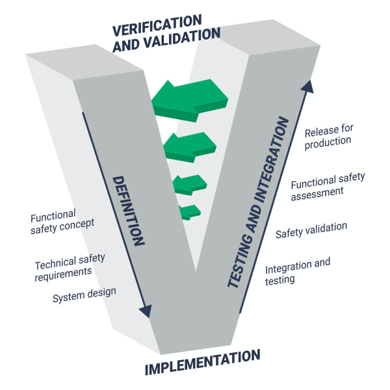
About Functional Safety
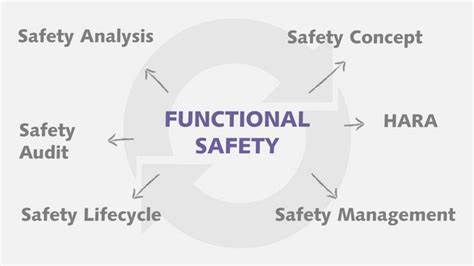
Ensuring the safety of complex technological systems is more important than ever in today’s automated and interconnected world. Industries such as automotive, manufacturing, and aerospace rely on advanced systems where failures can lead to serious consequences. Functional safety helps reduce these risks by ensuring that systems continue to operate safely even when faults or unexpected conditions occur.
Functional safety focuses on detecting potential failures and responding in a controlled way to prevent hazardous situations. This is achieved through safety mechanisms such as fault detection, redundancy, and safe shutdown procedures. International standards like ISO 26262 for automotive systems and IEC 61508 for industrial and electronic systems provide structured frameworks to identify hazards, assess risks, and implement appropriate safety measures.
Safety and Security Challenges of FuSa
Ensuring functional safety means developing systems that can detect faults, respond appropriately, and continue operating in a safe state even when problems occur. This is achieved through careful design, rigorous testing, and the implementation of safety measures such as redundancy, fault detection, and controlled shutdown mechanisms. By following established safety standards like ISO 26262 for automotive systems and IEC 61508 for industrial and electronic systems, organizations can systematically identify potential hazards, assess risks, and implement appropriate safeguards. Ultimately, functional safety helps protect human lives, valuable property, and the environment while ensuring that complex technological systems operate reliably and securely.
What is FuSa ?
Functional safety is often abbreviated as FuSa, a common term used in safety-critical industries. FuSa involves designing systems with mechanisms such as fault detection, redundancy, and safe shutdown procedures to prevent hazardous situations. To implement FuSa effectively, engineers follow established standards like ISO 26262 for automotive systems and IEC 61508 for industrial and electronic systems, which provide frameworks for identifying hazards, assessing risks, and ensuring safe system operation.
Approach to Safety & Security towards FuSa
Achieving functional safety involves five key steps: